Showing posts with label liberation. Show all posts

Thursday, September 22, 2011

Mooji: On the Conquest of Thought

"If we think for a moment that there is such a thing as thought, consciousness itself will appear as thought. That itself will appear as the world, and jivas, and as the Supreme. There will be misery arising out of it. Therefore, beloved, conquer thought easily by the certitude that there is no such thing as thought and all is Consciousness, and like this attain bliss."

"Conquest of thought alone is the great success. Conquest of thought alone is the great achievement. Conquest of thought alone is the great yoga. Conquest of thought alone is the great knowledge. Conquest of thought alone is the great purification. Conquest of thought alone is the great liberation. Conquest of thought alone is the removal of sorrow. Conquest of thought alone is the greatest happiness. But conquest of thought is, itself, the renunciation of thought, (and) the renunciation of thought is Consciousness."


-- Ribhu Gita --

Anthony Paul ("Mooji") Moo-Young
Basing his short lecture (below) on a reading from the Ribbhu Gita, spiritual teacher, Mooji, points out that the basic problem of human existence, the individual ego, arises from the individual's identification with the body-mind complex rather than the pure Being innate in each of us. Mahamaya, the great illusion that we are the body-mind and nothing more, arises when we wholly identify with our egoic thinking, and are thus blinded to the pure consciousness and Being within us.
"Egoic thought can only molest you when you are the body-mind identity," Mooji notes. "Mahamaya, the great illusion, can only overwhelm you when you carry the modification 'I am the body-mind', 'I am just a person.' No person can defeat that Mahamaya. It is only because the Parabrahman is inside you, the Supreme Being is inside you, that you can transcend maya.""

"(It is) only by limiting yourself to being the body-mind only," Mooji points out, that illusions and (more) illusions can enter. But because the Supreme Being is your Being, because you are identical with that, and that alone can transcend the effects of maya, that is the evidence that you are the Supreme Being. Because human beings have transcended maya."
"Nothing is either good or bad," wrote Shakespeare, "But our thinking makes it so."


Sunday, September 4, 2011

Yoga and the Concentration of the Mind

Yoga is the method of uniting, or "yoking," the innate Godhead within one's being with the ultimate Ground of Being that pervades and upholds the universe. In the second of his Yoga aphorisms (or sutras), the great sage, Patanjali, notes that, "Yoga is the control of the thought-waves of the mind." This, of course, implies that it is only the uncontrolled thought-waves of the mind that separate us from the realization of the Godhead within us. Indeed, Swami Satchidananda, in his commentary on Patanjali's yoga sutras, points out that "for the keen student this one sutra would be enough because the rest of them only explain this one."

In his writings, Swami Vivikenanda (one of the first persons to bring the teachings of India to the West), asks:
"How has all the knowledge of the world been gained but by the concentration of the powers of the mind? The world," he observes, "is ready to give up its secrets if we only know how to knock, how to give it the necessary blow. The strength and the force of the blow come through concentration. There is no limit to the power of the human mind," he points out, "(t)he more concentrated it is, the more power is brought to bear on one point." (I. 130-131.)
"The flow of this continuous control of the mind becomes steady," Vivikenanda notes, "when practiced day after day, and the mind obtains the faculty of constant concentration." (I. 273.)

"Concentration is the essence of all knowledge," he points out, "nothing can be done without it. Ninety per cent of thought force is wasted by the ordinary human being, and therefore he is constantly committing blunders; the trained man or mind never makes a mistake." (VI. 123-124.)

In relation to this Swami Satchitananda cites the Sanskrit saying: Mana eva manushyanam karanam bandha mokshayoho. "As the mind, so the man; bondage or liberation are in your mind."

"If you feel bound," notes Satchidananda, "you feel bound. If you are liberated, you feel liberated. Things outside neither bind nor liberate you," he points out, "only your attitude towards them does that." (Satchidananda, "The Yoga Sutras of Patanjali," p. 5.)

As an 'attitude' is only a conditioned, habitual way of thinking, the practice of yoga is unlearning such conditioned habits of thought, and thereby concentrating the mind into a focused instrument with which to probe the inner depths of one's being. For it is only in doing so that we can become capable of perceiving the All-in-All.

Sunday, July 10, 2011

On Desire and Desirelessness

"Desire is a subject upon which . . . true views can only be arrived at by an almost complete reversal of the ordinary, unreflecting opinion.
-- Bertrand Russell --
A seemingly unquenchable desire is the baseline state of the ego. Physical desire thwarted by circumstance or other people breeds anger. Sexual desire unfulfilled breeds lust. Existential desire unexamined breeds further ignorance as to our human condition. And these three states - anger, lust and ignorance - are, of course, the 'Three Poisons' which the Buddha identified as the ties that keeps the unawakened being bound to the wheel of samsara (continual rebirths) in a state of dukkha, or suffering.

Who amongst us has not been convinced at one time or another that obtaining that new car, house, job, new lover etc., would fulfill us? And who, two, three or six months later, has not been just as seemingly unhappy and unfulfilled after obtaining our heart's desire? And who amongst us has not struggled with the existential struggle over the inevitability of our own death? All these struggles, blind alleys, and frustrations are a result of our unexamined desires.

If, as is possible, we "master" desire, writes William Irvine, "we will experience what . . . has been the goal of most of those who have thought carefully about desire - a feeling of tranquility . . . marked by a sense that we are lucky to be living whatever life we happen to be living - that despite our circumstances, no key ingredient of happiness is missing."

"With this sense," Irvine observes, " comes a diminished level of anxiety: we no longer need to obsess over new things - a new car, a bigger house, a firmer abdomen - that we mistakenly believe will bring lasting happiness if only we can obtain them. Most importantly, if we master desire, to the extent it is possible to do so, we will no longer despise the life we are forced to live and will no longer daydream about living the life someone else is living; instead we will embrace our own life and live it to the fullest."
[William B. Irvine,"On Desire: Why We Want What We Want,"pp. 6-7.]

To master desire, however, requires a radical acceptance of what is, an attitude of unconditional love without conditions or even objects, an attitude I have described elsewhere as an acceptive consciousness which is as different from our ordinary, egoic self-consciousness, as such self-consciousness is from ordinary, unreflective animal consciousness.

One of the best aspirations for such a state of total acceptance and unconditional love is from an anonymous writer who observed:
"(A)cceptance is the answer to all my problems today. When I am disturbed, it is because I find some person, place thing or situation - some fact of my life - unacceptable to me, and I can find no serenity until I accept that person, place thing, or situation as being exactly the way it is supposed to be at this moment."

"Nothing, absolutely noting," he notes, "happens in God's world by mistake. . . . (U)nless I accept life completely on life's terms, I cannot be happy. I need to concentrate not so much on what needs to be changed in the world as on what needs to be changed in me and in my attitudes."
Paradoxically, to no want to gain, become or hold onto anything is itself a desire, if such is an aspiration for the future. If it is not an aspiration, but one's state of desireless being here and now, it is not. "We either makes ourselves happy or we make ourselves miserable," said Carlos Castenada's spiritual teacher, "the amount of effort is the same."

Tuesday, June 7, 2011

Emptiness and Dependent Origination: "Truth That Sets You Free"

"Emptiness," "insubstantiality" and "co-dependent origination" are fundamental concepts in Mahayana Buddhism, yet these concepts are also recognized realities in Daoist teachings, the teachings of many Indian philosophical and yoga schools, and - though not specifically referenced - most of the world's great wisdom traditions.

What we know of the origination and vast emptiness of the universe, as well as the mechanics and profound emptiness of the atom, makes these ancient philosophical realizations particularly relevant to all of us, although the Western worldview, to a large extent, still clings to its traditional materialist view of man, mind, the world and the cosmos.

In Chapter II of the Dao De Jing, we read:

"The thirty spokes converge at one hub,
But the utility of the cart is a function of the nothingness inside the hub.
We throw clay to shape a pot,
But the utility of the clay pot is a function of the nothingness inside it.
We bore out doors and windows to make a dwelling,
But the utility of the dwelling is a function of the nothingness inside it.
Thus, it might be something that provides the value,
But it is nothing that provides the utility."

[Ames and Hall, "Dao De Jin: A Philosophical Translation, page 91.]

"There is nothing," said Tzu-ch'i, "that is not a 'that' and nothing that is not a 'this.' One does not see from the standpoint of another knowing by oneself is knowing something. Therefore it is said: ''That' comes from 'this,' and 'this' is based on 'that.' This explains how 'that' and 'this' arise simultaneously."

"But when there is arising," he continued, "there is passing away; and when there is passing away, there is arising. When there is right, there is wrong; when there is wrong, there is right. By affirming we deny; by denying we affirm."

"Therefore," he notes, "sages do not go this way but perceive it in the context of nature. This is also based on an affirmation."

"A 'this' is also a 'that,' and a 'that' is also a 'this,' he concludes. "'That' is one judgment, and 'this' is also one judgment. Ultimately, are there in fact 'that' and 'this,' or are there no 'that' or 'this'? Nothing can be opposite to 'that and this' - we call this fact the pivot of the Way. When the pivot is centered in its hub, thereby responding infinitely, then affirmation is one infinity and negation is also one infinity."
[Clearey, "The Essential Tao," page 72.]

Vedantists, and other Indian philosophical and yoga schools, label this concept of "this and that,' or 'neither this nor that,' "sunyata" - a transcendental  state in which neither 'this' nor 'that' exists absolutely. In "The Spiritual Heritage of India," Vedantist scholar, Swami Prabhavananda, suggests that these concepts extend to all the world's great wisdom traditions, including Christianity, and that the transcendental reality in which this is experienced can be attained by all.
"The nirvana of Buddha," writes Prabhavananada, "is . . . not a state of annihilation but the attainment of the unchangeable reality, which can be positively described as the eternal peace. But what this peace really is, no words can define; all definition can be only symbol and can offer only a vague suggestion. Buddha employs negative terms for its description, such as freedom from misery and death, freedom from sensuality, from the ego, from delusion, from ignorance."

"This state of freedom is attainable by the 'noble kind of wisdom' - a phrase already quoted from the Buddhist scripture and signifying what the Vedanta calls transcendental knowledge. The wisdom meant is not a wisdom of the intellect, which implies a knower and an object, but rather a state, sunyata, in which no subject-object relation exists, and in which one transcends both intellect and mind - these two words representing, in Hindu psychology, separate entities."

"Christ refers directly to this transcendental wisdom when he says: 'And ye shall know the truth and the truth shall set you free.' It is identical with perfection, the same perfection that Christ has in mind when he says: 'Be ye therefore perfect, even as your Father which is in heaven is perfect.' It is, in brief, the direct, immediate knowledge of that which is timeless unconditional existence."

"The 'noble kind of wisdom' is attainable by 'the noble conduct of life' and 'the noble earnestness of meditation.'"
[Swami Prabhavananda, "The Spiritual Heritage of India," page 186.]

Sunday, May 1, 2011

Tolle and Adyashanti: What is Enlightenment?

The man or woman seeking meaning in their life is bound at some time to hear of enlightenment. But what is enlightenment, really? And where are we to find it? At the feet of a guru? Perhaps? At the top of a mountain? Maybe. In a corner bar, a bottle of pills, a love affair or a new car?  Highly, highly unlikely.

Andrew Cohen, Editor-in-chief,
of EnlightenNext magazine.
The enlightened spiritual teacher, Andrew Cohen, wrote an entire book called "Enlightenment is a Secret." In it, he remarked:
"Enlightenment is a secret that very few people know about and even fewer understand. Why is it a secret? Because Enlightenment does not exist in time. That why it's a secret and that's why it will always be a secret. Enlightenment is a vision that cannot be held or grasped in any way. Beyond this world it's a mystery that is exploding. A fire that is burning. It's a fire that a person is either going to jump into or run away from. This fire burns beyond the mind. No-time is the place where this secret abides. Realize that and you realize the Self you are when there's no mind and no time. Realize that and cling to that alone as your own Self.
The  great Sufi poet and teacher, Rumi, asked us to judge the moth by the worthiness of the candle it immolates itself in. "Enlightenment is not far away," Cohen insists. "It does not need to take time."

Below, two modern enlightened teachers, best-selling author of "The Power of Now," Eckhart Tolle and the neo-Buddhist teacher and author, Adyashanti, tackle the question of just what enlightenment is.

. . . . . . . . . . . . .

Eckhart Tolle
Enlightenment, or the egoless state, "cannot be achieved in the future, or in time," Eckhart Tolle notes. "It is only by looking through it now, that the egoless state is here, now."

"A state that you want to achieve is a mental concept that is endowed with self," he observes. "And, as such, you can never reach it because it is an abstract concept of 'who I want to be,' not realizing you are it already."

"So the egoless state does not lie in the future. It has nothing to do with the future," he says. "You cannot make it into a goal. You cannot make - whether you call it the egoless state, or whether you call it enlightenment - you cannot make it into a goal. 'Goal' implies future," he observes, and "the very entry point into the egoless state or enlightenment is the present moment."

"If you make (enlightenment) into a goal you want to achieve," says Tolle, "you miss the entry point, because you are looking to the future."

"That is the dilemna of all spiritual seekers," he observes. "Because they listen to a spiritual talk or read a spiritual book and say, 'There is such a thing as the egoless state, or the enlightened state, and perhaps I can achieve it too.' And immediately they make it into a goal (and) project it away. It becomes mind, a mental image of 'who' I want to 'be' (in the) future. And (they do) not realize that their very search to actualize that image prevents them from being it, now. Because the entry point is here, (in) this moment only. The ego can only be transcended through accessing the power of the present moment." There is, he says, "no other way."

"Enlightenment is only in the power of the present moment," Tolle notes, "nowhere else. It is only humans who give up the search who realize it is already here. So you have to, one way or another - either because you are totally frustrated with the spiritual search, or because you suddenly see the truth of it -  give up the  search, as if (enlightenment) is in the future."


Adyashanti
"Enlightenment," says Adyashanti, "is simply not perceiving through ego. It's not seeing life or any thing - self, others, your tennis shoes, your cat, your dog, your livelihood, anything - it's just not seeing the world, not seeing everything through the distortion called the egoic state of consciousness. "

"That is why," he observes, "(enlightenment) is likened to the natural state. Natural, meaning its not an alternative distorting lens, it's just perception without a lens, without a distortion. Ultimately, that is what enlightenment is. It is perception without distortion."

Cautioning his audience that enlightenment is not an unending blissful experience of what Zen Buddhists call satori, Adyashanti observes that, "in the end enlightenment has very little to do with enlightenment experiences. It is simply not perceiving through the lens of ego."

'There is no doubt, he says, "that it is pretty good not perceiving through the lens of ego, it's happiness, it's peace, it's the end of your search. Not that you find anything, except sanity. Not that you attain anything, except seeing things as they actually are. And that's what nirvana is, seeing things as they actually are."

"Enlightenment," says Adyashanti, "is the unaltered state of consciousness. Consciousness needs no alteration to see that everything is one. Since everything is one, you don't need an unaltered state of consciousness to perceive that everything is one. You need an altered state of consciousness to see that everything is not one."

Friday, April 29, 2011

Absent-Mindedness and the Four States of Consciousness

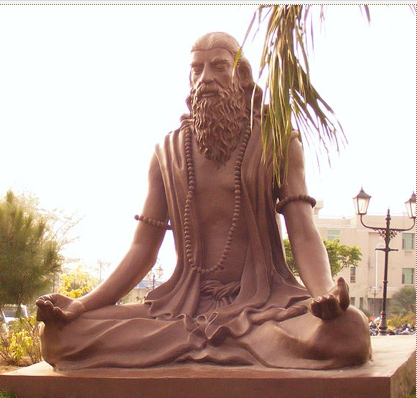
Statue of Patanjali, Haridwar, India
In the Vedanta, there are usually four classifications of consciousness: dreamless sleep, dream sleep, ordinary consciousness, and a fourth transcendental state (divided, perhaps, into varying subtle sub-states). In his yoga sutras, the ancient sage and grammarian, Patanjali, explores the three ordinary states of consciousness and how to attain, though progressively disciplining the thought waves of the mind, the fourth, transcendental state of consciousness.

In his book, "Relativity, Philosophy and Mind," the philosopher and polymath spiritual seeker, Paul Brunton, commented on these differing states of consciousness, noting:
Paul Brunton (1898-1982)
"A man never leaves Consciousness. The world comes into it as perception, that is as idea. Whether anything, object or state, comes into it or not, consciousness remains as his unchanging home. Whether asleep or awake, wrapped in himself or out in the world, his essential being remains what it is. His thoughts and sense-impressions, feelings and passions are produced by it or projected from it: they exist in dependence on it and die in it."

"(E)ven deep sleep unconsciousness is a form of this "consciousness" which transcends all the states we ordinarily know - waking, dream and deep sleep - yet includes them when they merge back into it. Such a "consciousness" is unthinkable, unimaginable, but it is the true objective awareness. It is also the I you are seeking so much. But to reach it, then you have to let go of the I which you know so well."
["The Notebooks of Paul Brunton," vol. 13, para 183-184]
In the video embedded below, Paramahansa Nithyananada comments on the classical yoga teachings of Patanjali, 2,000 year old teachings that deal extensively with the four states of consciousness in setting out the yoga techniques which are required to reach the fourth transcendental state. The problem for the vast majority of people, however, Nithyananda notes, is that even in our waking state we are prone to be absent-minded or "dreaming."

Paramahansa Nithyananda
"The whole of humanity is sleep walking, except the man who is awakened, the man who is enlightened," says Paramahansa Nethyananda in his explanation of Patanjali's yoga sutras. "Being absent-minded, not being alive in the state in which you are is what I call 'sleep.' . . . Otherwise (for) all problems you face, you have a solution."

"There is no problem which cannot be solved," he notes. "All problems can be completely solved with only one thing: You need to be available. . . . All problems are created when you are not available. When you are not available you mess up the whole thing."

"Because of absent-mindedness people miss many things," says Nithyananda, "their relationships, their life, their positions. Many things get missed. (Being) absent-mindedness during talking with others, or during your your activities, you will lose your worries. (Being) absent-mindedness during your inner planning, inner visualization, inner thinking, (we) understand is the worst one. You will miss some (important) links."

If you are "absent -mindedness in your outer world," he observes, "you lose only things of the outer world. . . . But forgetting to keep your (inner) thoughts, you lose the things that you really need in your life. You lose too many big things."


Tuesday, April 5, 2011

Thomas Merton: "Shining Like the Sun"

"I have the immense joy of being man, a member of a race in which God Himself became incarnate. As if the sorrows and stupidities of the human condition could overwhelm me, now that I realize what we all are. And if only everybody could realize this! But it cannot be explained. There is no way of telling people that they are all walking around shining like the sun."

-- Thomas Merton, O.C.S.O. --

The quotation, above, is but part of a description of an "epiphany" experienced by the famed Trappist Monk, Thomas Merton, as described in his book, "Conjectures of a Guilty Bystander."

Thomas Merton (1915 -1968)
While Merton wrote in excess of seventy books (and has been the subject of many score more since his death by accidental electrocution in 1968), it is Merton's 'epiphany' moment, and his famous "shining like the sun" passage, that stand out from, and helps define, his larger body of work - much like Krishnamurti's famous "the Truth is a pathless land" quote.

(His "waking from a dream of separateness" and comments on "illusion" in the first paragraph of the "shining like the sun" passage are not uncoincidentally also reminiscent of Einstein's comments about our suffering from a "cosmic illusion of consciousness," which creates the seeming separation of the ego.)

Merton, in his "Conjectures of a Guilty Bystander," writes:
In Louisville, at the corner of Fourth and Walnut, in the center of the shopping district, I was suddenly overwhelmed with the realization that I loved all those people, that they were mine and I theirs, that we could not be alien to one another even though we were total strangers. It was like waking from a dream of separateness, of spurious self-isolation in a special world, the world of renunciation and supposed holiness. The whole illusion of a separate holy existence is a dream. Not that I question the reality of my vocation, or of my monastic life: but the conception of “separation from the world” that we have in the monastery too easily presents itself as a complete illusion: the illusion that by making vows we become a different species of being, pseudo-angels, “spiritual men,” men of interior life, what have you."
"Certainly these traditional values are very real, but their reality is not of an order outside everyday existence in a contingent world, nor does it entitle one to despise the secular: though “out of the world,” we are in the same world as everybody else, the world of the bomb, the world of race hatred, the world of technology, the world of mass media, big business, revolution, and all the rest. We take a different attitude to all these things, for we belong to God. Yet so does everybody else belong to God. We just happen to be conscious of it, and to make a profession out of this consciousness. But does that entitle us to consider ourselves different, or even better, than others? The whole idea is preposterous."
"This sense of liberation from an illusory difference was such a relief and such a joy to me that I almost laughed out loud. And I suppose my happiness could have taken form in the words: “Thank God, thank God that I am like other men, that I am only a man among others.” To think that for sixteen or seventeen years I have been taking seriously this pure illusion that is implicit in so much of our monastic thinking."
"It is a glorious destiny to be a member of the human race, though it is a race dedicated to many absurdities and one which makes many terrible mistakes: yet, with all that, God Himself gloried in becoming a member of the human race. A member of the human race! To think that such a commonplace realization should suddenly seem like news that one holds the winning ticket in a cosmic sweepstake."
"I have the immense joy of being man, a member of a race in which God Himself became incarnate. As if the sorrows and stupidities of the human condition could overwhelm me, now that I realize what we all are. And if only everybody could realize this! But it cannot be explained. There is no way of telling people that they are all walking around shining like the sun."
"This changes nothing in the sense and value of my solitude, for it is in fact the function of solitude to make one realize such things with a clarity that would be impossible to anyone completely immersed in the other cares, the other illusions, and all the automatisms of a tightly collective existence. My solitude, however, is not my own, for I see now how much it belongs to them — and that I have a responsibility for it in their regard, not just in my own. It is because I am one with them that I owe it to them to be alone, and when I am alone, they are not “they” but my own self. There are no strangers!"
"Then it was as if I suddenly saw the secret beauty of their hearts, the depths of their hearts where neither sin nor desire nor self-knowledge can reach, the core of their reality, the person that each one is in God’s eyes. If only they could all see themselves as they really are. If only we could see each other that way all the time. There would be no more war, no more hatred, no more cruelty, no more greed. . . I suppose the big problem would be that we would fall down and worship each other. But this cannot be seen, only believed and “understood” by a peculiar gift."
(Emphasis added.)
Merton was a staunch advocate for, and enthusiast of, interfaith conversation and understanding. A 'giant' himself, he pioneered dialogues with many Eastern spiritual 'giants', including the Dalai Lama, D.T. Suzuki, the Japanese Zen master and writer who was so influential in introducing the Zen Buddhist tradition to the United States, and the Vietnamese monk and anti-war activist, Thich Nhat Hanh, whom Martin Luther King Jr. nominated for the Nobel Peace prize.

Fittingly, the recent unveiling of an historical plaque, and the designation of Fourth Avenue and Walnut Street in Louisville as "Thomas Merton Square," was accompanied by an inter-faith reading of Merton's famous "Shining Like the Sun" quote at the site of his personal epiphany.


Saturday, March 19, 2011

Ending the 'Optical Delusion of Consciousness' to Demonstrate 'True Compassion'

"A human being is part of the whole called by us the universe, a part limited in time and space. We experience ourselves, our thoughts and feelings as something separate from the rest. A kind of optical delusion of consciousness."

"This delusion is a kind of prison for us, restricting us to our personal desires and to affection for a few persons nearest to us. Our task must be to free ourselves from the prison by widening our circle of compassion to embrace all living creatures and the whole of nature in its beauty."

"The true value of a human being is determined by the measure and the sense in which they have obtained liberation from the self. We shall require a substantially new manner of thinking if humanity is to survive."

(Albert Einstein, 1954)
The primary basis of all the world's great wisdom traditions and religions is love - not "love" in a personal sense, per se, but a love without conditions and without any particular object. And, of course, the result of this unconditional, all-inclusive love is the 'compassion' Einstein speaks of, or what the Dalai Lama calls "unbiased compassion."


"Compassion,' from the Greek 'pathos" (meaning suffering), means that we recognize the suffering - both physical and psychological - of others, and that in a very real sense their suffering invokes suffering within us. Interestingly, realization of the Buddha's 'First Noble Truth' on the path to enlightenment, or "liberation from the self" (the 'Noble Truth of Suffering') is that to the 'unawakened' mid or 'imprisoned' mind, this life is dukkha, or "suffering." Einstein realized, as the Buddha did 2500 years before this time, that what the individual (indeed the world) needs to survive and flourish is "a substantially new way of thinking."

Today, as ever, there is an imperative need for this new way of thinking; or, as spiritual teacher Andrew Cohen explains,  there is an "urgency" for individuals to seek enlightened consciousness and adopt a purposive relationship to the attainment of that rarified state of being, not for themselves alone, but for the sake of others - for the sake of the Whole. We need, as others teachings have long advocated, to become what may be thought of as 21st century bhoddisatvas, vowing not to give up until there is a broad based enlightenment  - or the adoption of "a substantially new manner of thinking," to use Einstein's phraseology - amongst all human (and other sentient) beings.
Andrew Cohen, Editor-in-Chief,
EnlightenNext Magazine


The vow of a boddhisatva - even a 21st century boddhisatva - like all things spiritual, it seems, is somewhat paradoxical: There is a need for individuals to awaken spiritually for the sake of all humanity; yet, in obtaining spiritual enlightenment, individuality slips away. As Cohen observes in his book, "Enlightenment Is a Secret:"
"The most delicate and difficult task possible to accomplish in this life is simply to be Free. One who succeeds is very rare. It is hardly ever seen. If a person can be Free it is the greatest blessing. It means an alternative to the human mess is possible. Simply being awake and staying awake is a demonstration of the solution. Living Freedom is the solution. You become the answer. You become the solution. Few have the courage to do it.
And yet . . . this aspiration to be "the solution," even for the sake of the Whole, remains personal and therefore paradoxical. While all the violence and suffering that is rampant may make it seem that it is "a very selfish endeavour" to seek a higher state of consciousness and being for oneself, Cohen observes that, "Nothing could be further than the truth."
"You are doing the human race the highest service by realizing your Self," he notes. "Self-Realization is evolution. Coming to the end of aggressive, destructive and selfish behavior is evolution is action. When you evolve to the point that you are able to actively manifest the profound understanding discovered in Self-Realization you are cooperating with all the forces of nature. Only then will your own life be the very expression of the opposite of everything you claim to abhor. What more can you possibly do? What more can anyone possibly do than that? When you have Realized your Self you simply 'are.' When you have found that harmony that you are, then you will be the harmony and no longer an obstruction to it. When sturggle has come to an end, so does all division."
The end of "all division" is the end of Einstein's "optical delusion of consciousness," of course. It is the attainment of a wholly "new manner of thinking" that Einstein would undoubtedly acknowledge as the necessary state which we all need to demonstrate "true compassion."

Monday, March 14, 2011

What Is Required to Become a True Human 'Being'?

"Relieve me of the bondage of self . . ."
What is required of us to 'slip the bondage, of our narrow, egoic self-consciousness, to be come true human 'beings' rather than human 'thinkings'? For most of us, the problem is the continual 'inner dialogue' of our rudimentary "self" consciousness, what the pioneering psychologist, William James, dubbed the "stream of consiousness."

We miss the wonders of life - indeed, the wonder of "life" itself - through our continuous identification with, attachment to, and fixation upon this narrow, self-centered identity and attachment. As Einstein noted:
"A human being is a part of the whole, called by us, "Universe," a part limited in time and space. He experiences himself, his thoughts and feelings as something separated from the rest -- a kind of optical delusion of his consciousness.

This delusion is a kind of prison for us, restricting us to our personal desires and to affection for a few persons nearest to us. Our task must be to free ourselves from this prison by widening our circle of compassion to embrace all living creatures and the whole of nature in its beauty.”
While Einstein believed that no one may break out of this "prison" completely and permanently, he observed that, "the striving for such achievement is in itself a part of the liberation and a foundation for inner security." Many others - from all traditions, places and times - do believe that a complete liberation (in the form of enlightenment, mystic union, moksha, nirvana, or whatever you may call it) is possible, but that it takes great effort. 

"Remember that the most difficult tasks are consummated not by a single explosive burst of energy or effort, but by consistent daily application of the the best you have within you. To change one's life for the better, to resurrect one's body and mind from living death requires many positive steps, one in front of the other, with your sights always on your goal. . . . The means of transportation, and the power to break your intertia must be generated by forces long dormant but still alive within you."
                               (Og Mandino, "The Greatest Miracle in the World")
One of the most renowned spiritual teachers ever put it this way: "The harvest is plentiful, but the laborers are few". (Matt. 9:37) Or, as Don Juan, the Native American nagual who was Carlos Castenada's teacher, observed: "The trick is in what one emphasizes. We either make ourselves miserable, or we make ourselves strong. The amount of work is the same."

And there is the consensus of the many different paths to spiritual enlightenment and liberation from Einstein's "optical delusion." One must work on one's spiritual condition and the level of one's consciousness continuously, unrelentingly, and with great effort in order to attain liberation from the ego.

For as Sri Krishna tells Arjuna in the Bhagavad Gita: "(O)ut of thousands of people only one will seek Me, and out of thousands who seek Me only one will perceive Me as I Am."