Showing posts with label Vedanta. Show all posts

Thursday, September 22, 2011

Mooji: On the Conquest of Thought

"If we think for a moment that there is such a thing as thought, consciousness itself will appear as thought. That itself will appear as the world, and jivas, and as the Supreme. There will be misery arising out of it. Therefore, beloved, conquer thought easily by the certitude that there is no such thing as thought and all is Consciousness, and like this attain bliss."

"Conquest of thought alone is the great success. Conquest of thought alone is the great achievement. Conquest of thought alone is the great yoga. Conquest of thought alone is the great knowledge. Conquest of thought alone is the great purification. Conquest of thought alone is the great liberation. Conquest of thought alone is the removal of sorrow. Conquest of thought alone is the greatest happiness. But conquest of thought is, itself, the renunciation of thought, (and) the renunciation of thought is Consciousness."


-- Ribhu Gita --

Anthony Paul ("Mooji") Moo-Young
Basing his short lecture (below) on a reading from the Ribbhu Gita, spiritual teacher, Mooji, points out that the basic problem of human existence, the individual ego, arises from the individual's identification with the body-mind complex rather than the pure Being innate in each of us. Mahamaya, the great illusion that we are the body-mind and nothing more, arises when we wholly identify with our egoic thinking, and are thus blinded to the pure consciousness and Being within us.
"Egoic thought can only molest you when you are the body-mind identity," Mooji notes. "Mahamaya, the great illusion, can only overwhelm you when you carry the modification 'I am the body-mind', 'I am just a person.' No person can defeat that Mahamaya. It is only because the Parabrahman is inside you, the Supreme Being is inside you, that you can transcend maya.""

"(It is) only by limiting yourself to being the body-mind only," Mooji points out, that illusions and (more) illusions can enter. But because the Supreme Being is your Being, because you are identical with that, and that alone can transcend the effects of maya, that is the evidence that you are the Supreme Being. Because human beings have transcended maya."
"Nothing is either good or bad," wrote Shakespeare, "But our thinking makes it so."


Thursday, July 28, 2011

Contemplative Practice and Disciplining the Mind

"You tell me nothing new; you are not the only one that is troubled with wandering thoughts. Our mind is extremely roving; but, as the will is mistress of all our faculties, she must recall them, and carry them to GOD as their last end."

"When the mind, for want of being sufficiently reduced by recollection at our first engaging in devotion, has contracted certain bad habits of wandering and dissipation, they are difficult to overcome, and commonly draw us, even against our wills, to the things of the earth."

"I believe one remedy for this is to confess our faults, and to humble ourselves before GOD. I do not advise you to use multiplicity of words in prayer: many words and long discourses being often the occasions of wandering. Hold yourself in prayer before GOD, like a dumb or paralytic beggar at a rich man's gate. Let it be your business to keep your mind in the presence of the LORD. If it sometimes wander and withdraw itself from Him, do not much disquiet yourself for that: trouble and disquiet serve rather to distract the mind than to re-collect it: the will must bring it back in tranquility. If you persevere in this manner, GOD will have pity on you."

"One way to re-collect the mind easily in the time of prayer, and preserve it more in tranquility, is not to let it wander too far at other times: you should keep it strictly in the presence of GOD; and being accustomed to think of Him often, you will find it easy to keep your mind calm in the time of prayer, or at least to recall it from its wanderings."
-- Brother Lawrence --
("The Practice of the Presence of God," VIII Letter)
That the undisciplined mind is restless, and goes where it will, is recognized in all religions. Indeed, disciplining the mind may be the central purpose of religion, as through disciplining the mind we attain to a higher and deeper consciousness in which we attain to the divine. "The mind is indeed restless, Arjuna," says Krishna in the Bhagavad Gita, "it is indeed hard to train. But by constant practice and by freedom from passions the mind in truth can be trained. When the mind is not in harmony, this divine communion is hard to attain; but the man whose mind is in harmony attains it, if he knows and strives for it."

"(E)very mind, no matter its present nature, can ultimately be disciplined and transformed" observes Swami Prabhavananda in his commentary on Patanjali's Yoga Sutras, "(and) can be, in Patanjali's phrase 'one-pointed' and fit to attain to the state of perfect yoga." However, as he later notes, disciplining the mind requires both practice and effort.
"(T)he thought-waves cannot all be controlled at once," Prabhavananda observes. "First we have to overcome the "painful" thought-waves by raising waves which are "not painful." To our thoughts of anger, desire and delusion we must oppose thoughts of love, generosity and truth. Only much later, when the "painful" thought-waves have been completely stilled, can we proceed to the second stage of discipline; the stilling of the "not painful" waves which we have deliberately created."

"The idea that we should ultimately have to overcome even those thought-waves which are "good," "pure" and "truthful" may at first seem shocking to a student who has been trained in the Western approach to morality," notes Prabhavananda, "but a little reflection will show him that this must be so."

"The external world, even in its most beautiful appearances and noblest manifestations, is still superficial and transient," he notes. "It is not the basic Reality. We must look through it not at it to see the Atman."

"Certainly," he concedes, "it is better to love than to hate, better to share than to hoard, better to tell the truth than to lie. But the thought-waves which motivate the practice of these virtues are nonetheless disturbances in the mind. We all know instances of admirable, earnest men who become so deeply involved in the cares of a great reform movement or social relief project that they cannot think of anything beyond the practical problems of their daily work. Their minds are not calm." 
"The mind of the truly illumined man is calm," Prabhavananda concludes, "not because he is selfishly indifferent to the needs of others, but because he knows the peace of the Atman within all things, even within the appearance of misery, disease, strife and want."
 [Prabhavananda and Isherwood, " How to Know God: The Yoga Aphorisms of Patanjali," pp. 23-24.]

Tuesday, July 12, 2011

Religion, Ecumenical Faith and Science: Eastern and Western Perspectives

"Religion must be studied on a broader basis than formerly. All narrow, limited fighting ideas of religion must go. All sect ideas and tribal or national ideas of religion must be given up. That each tribe or nation should have its own particular God, and think that every other is wrong, is a superstition that should belong to the past. All such ideas should be abandoned."
-- Swami Vivikenanda -- 
Written early in the last century, Swami Vivikenanda's advocacy of a universal tolerance for all religions is based on a recognition that, in essence, all religions contain the same impartial truths,  truths that are not inherently conflictive with other faiths or, indeed, with science.
"Religion," Vivkenanda points out, "is the manifestation of Divinity already in man. . . . (and) the proof of one religion depends on the truth of all the rest."

"For instance," he reasons, "if I have six fingers, and no one else has, you may well say that is abnormal. The same reasoning may be applied to the argument that only one religion is true and all others false. One religion only, like one set of six fingers in the world, would be unnatural. We see, therefore, that if one religion is true, all others must be true. There are differences in non-essentials, but in essentials they are all one."
[Vivikenanda, "Teachings of Swami Vivikenanda," (Advaita Ashrama), p. 237.]
In the revised Catechism of the Catholic Church, released in 1994, we see a similar, yet guarded, recognition of the ecumenical nature of religion expressed by what has historically been one of the most exclusionary of faiths. After acknowledging the special bonds with both Judaism and Islam, the revised Catechism acknowledges the following:
"The Church's bond with non-Christian religions is in the first place the common origin and end of the human race:
All nations form but one community. This is so because all stem from the one stock which God created to people the entire earth, and also because all share a common destiny, namely God. . . .
The Catholic Church recognizes in other religions that search, among shadows and images, for the God who is unknown yet near since he gives life and breath and all things and wants all men to be saved."
["Catechism of the Catholic Church'" paras. 839-842.]
And what about the relationship between religion and science? "Is religion," Vivikenanda asks, "to justify itself by the discoveries of reason, through which every other concrete science justifies itself? Are the same methods of investigation which we apply to sciences and knowledge outside, to be applied to the science of Religion?"

"In my opinion," Vivikenanda observes, "this must be so, and I am also of (the) opinion that the sooner it is done the better. If a religion is destroyed by such investigations, it was then all the time useless, unworthy superstition; and the sooner it goes the better. I am thoroughly convinced that its destruction would be the best thing that could happen. All that is dross will be taken off, no doubt, but the essential parts of religion will emerge triumphant out of the investigation. Not only will it be made scientific, as scientific, at least, as any of the conclusions of physics or chemistry, but will have greater strength, because physics or chemistry has no internal mandate to vouch for its truth, which religion has."
[Vivikenanda, "Teachings of Swami Vivikenanda," (Advaita Ashrama), pp. 237-238.]

For his part, roughly 100 years after Vivkenanda's time, Pope Benedict XVI has moved radically towards a resolution and reconciliation of religion and science. In addressing a Vatican conference into the origin of life in the universe (held on October 31, 2008), he made the following comments:
"(Q)uestions concerning the relationship between science’s reading of the world and the reading offered by Christian Revelation naturally arise. My predecessors Pope Pius XII and Pope John Paul II noted that there is no opposition between faith’s understanding of creation and the evidence of the empirical sciences. Philosophy in its early stages had proposed images to explain the origin of the cosmos on the basis of one or more elements of the material world. This genesis was not seen as a creation, but rather a mutation or transformation; it involved a somewhat horizontal interpretation of the origin of the world. A decisive advance in understanding the origin of the cosmos was the consideration of being qua being and the concern of metaphysics with the most basic question of the first or transcendent origin of participated being. In order to develop and evolve, the world must first be, and thus have come from nothing into being. It must be created, in other words, by the first Being who is such by essence."

"To state that the foundation of the cosmos and its developments is the provident wisdom of the Creator is not to say that creation has only to do with the beginning of the history of the world and of life. It implies, rather, that the Creator founds these developments and supports them, underpins them and sustains them continuously. Thomas Aquinas taught that the notion of creation must transcend the horizontal origin of the unfolding of events, which is history, and consequently all our purely naturalistic ways of thinking and speaking about the evolution of the world. Thomas observed that creation is neither a movement nor a mutation. It is instead the foundational and continuing relationship that links the creature to the Creator, for he is the cause of every being and all becoming (cf. Summa Theologiae, I, q.45, a. 3)."

"To 'evolve' literally means 'to unroll a scroll,' that is, to read a book. The imagery of nature as a book has its roots in Christianity and has been held dear by many scientists. Galileo saw nature as a book whose author is God in the same way that Scripture has God as its author. It is a book whose history, whose evolution, whose “writing” and meaning, we “read” according to the different approaches of the sciences, while all the time presupposing the foundational presence of the author who has wished to reveal himself therein. This image also helps us to understand that the world, far from originating out of chaos, resembles an ordered book; it is a cosmos. Notwithstanding elements of the irrational, chaotic and the destructive in the long processes of change in the cosmos, matter as such is “legible”. It has an inbuilt “mathematics”. The human mind therefore can engage not only in a “cosmography” studying measurable phenomena but also in a “cosmology” discerning the visible inner logic of the cosmos. We may not at first be able to see the harmony both of the whole and of the relations of the individual parts, or their relationship to the whole. Yet, there always remains a broad range of intelligible events, and the process is rational in that it reveals an order of evident correspondences and undeniable finalities: in the inorganic world, between microstructure and macrostructure; in the organic and animal world, between structure and function; and in the spiritual world, between knowledge of the truth and the aspiration to freedom. Experimental and philosophical inquiry gradually discovers these orders; it perceives them working to maintain themselves in being, defending themselves against imbalances, and overcoming obstacles. And thanks to the natural sciences we have greatly increased our understanding of the uniqueness of humanity’s place in the cosmos."
To reconcile one's religion with all "other" religions is the great task for every individual, while reconciling religion with science is the great task of all religionists and scientists alike.

Monday, June 27, 2011

Vivikenanda: On Instinct, Reason and Inspiration

"Unity in variety is the plan of the universe. As a man you are separate from an animal, but as living beings man, woman, animal and plant are all one; and as existence you are one with the whole universe. That universal essence is God, the ultimate Unity in the universe. In him we are all one. At the same time, in manifestation these differences must always remain."
-- Swami Vivikenanda --
"We find in all beings three sorts of instruments of knowledge," Vivikenanda writes. "The first is instinct which you find most highly developed in animals; this is the lowest instrument of knowledge. What is the second instrument of knowledge? Reasoning. You find that most highly developed in man."

"Now in the first place," Vivikenanda observes, "instinct is an inadequate instrument; to animals the sphere of action is very limited, and within that limit instinct acts. When you come to man, you see it is largely developed into reason. The sphere of action also has bere become enlarged. Yet even reason is still insufficient. Reason can go only a little way and then it stops, it cannot go any farther; and if you try to push it the result is helpess confusion; reason becomes unreasonable."

"Logic becomes argument in a circle," he notes. "Take for instance the very basis of our perception - matter and force. What is matter? That which is acted upon by force. And force? That which acts upon matter. You see the complication, what the logicians call a seesaw, one idea depending on the other, and this again depending on that."

"You find a mighty barrier before reason, beyond which reasoning cannot go," he points out. "Yet it always feels impatient to get into the region of the Infinite beyond. This world, this universe which our senses feel or our mind thinks, is but one atom, so to say, of the Infinite, projected on to the plane of consciousness. Within that narrow limit defined by the network of consciousness works our reason, and not beyond. Therefore there must be some other instrument to take us beyond, and that instrument is called inspiration."

"So instinct, reason, and inspiration are the three main instruments of knowledge," says Vivikenanda. "Instinct belongs to animals, reason to man, and inspiration to God-men. But in all human beings are to be found in more or less developed conditions the germs of all these three instruments of knowledge. To have these mental instruments evolved, the germs must be there. And this must also be remembered, that one instrument is a development of another and therefore does not contradict it."

"It is reason that develops into inspiration," Vivikenanda concludes, "and therefore inspiration does not contradict reason, but fulfills it. Things which reason cannot get at are brought to light by inspiration, and they do not contradict reason. The old man does not contradict the child, but fufills the child."

Thursday, June 23, 2011

Non-Attachment: From Meditation to Samadhi

Non-attachment to the perceptions of the world - non-attachment to our ideas of its people, places, things and situations - is an essential component of spiritual practice, irrespective of religious tradition. "In the end what matters most," reads a banner in my living room, "is how well did you live, how well did you love, how well did you learn to let go." Poignant words, for one day we all have to let go of everything, and all that will attest to our being here this time around, is how well we lived our lives and how well we loved the beings we encountered.

In his enlightening book, "How to Know God: The Yoga Aphorisms of Patanjali" (written with Christopher Isherwood), Swami Prabhavananda notes that "(i)f we try to concentrate (in meditation) while remaining attached to the things of this world, we shall fail altogether or our newly acquired powers of concentration will bring us into great danger, because we shall inevitably use them for selfish, unspiritual ends." (He points to the violent excesses of the twentieth-century as evidence of what happens when man concentrates on science "without unlearning his attachment to nationalistic power.")

But how, then, are we to learn such detachment from the ego and its desires for the objects and ambitions that the world presents? "We must begin," says Prabhavananda, "by cultivating attachment to the highest object we can conceive of, to God himself."

First, he suggests, concentrate upon a spiritual ideal - Christ, Krishna, the Buddha, or his own teacher, Ramakrishna - and as attachment to that ideal is generated, lesser attachments to the people, places and things of the world slip away. This, Prabhavananda says, effects non-attachment at the level "of gross phenomena."

Next, Prabhavananda suggests, as meditation and contemplation on our ideal progresses, we lose attachment to the ideal as we gain understanding to the spirit within him or her. At that stage, he observes, we move "from the level of gross phenomena to the subtle or spiritual level." At this point, "(w)e shall no longer admire a Christ or a Ramakrishna as human beings within time, but we shall worship them as eternal, spiritual beings. We shall know them in their divine aspect."

From there, says Prabhavananda, there is a third stage, or "third level of consciousness" that transcends even attachment to these subtle forms. "For behind Christ," he points out, "behind Ramakrishna, behind any conception of a personal God, there is Brahman, the Ground, the central Reality of which these figures are only partial, individual projections."

"When we become united with Brahman," Prabhavananda notes, "we are united with That which was manifested in Christ and hidden within our unregenerate selves, but which is eternally present in all of us. And this union is the state of nirvikalpa samadhi."

In describing just what nirvikalpa samadhi is, Prabhavananda leans on the following description by the great seventh-century Vedantist teacher, Shankara:
"There is a continuous consciousness of the unity of Atman and Brahman. There is no longer any identification of the Atman with its coverings. All sense of duality is obliterated. There is pure, unified consciousness. The man who is well established in this consciousness is said to be illumined."

"A man is said to be free even in this life when he is established in illumination. His bliss is unending. He almost forgets this world of appearances.

"Even though his mind is dissolved in Brahman, he is fully awake, free from the ignorance of waking life. He is fully conscious, but free from any craving. Such a man is said to be free even in this life."

"For him, the sorrows of this world are over. Though he possesses a finite body, he remains unitied with the Infinite. His heart knows no anxiety. Such a man is said to be free even in this life."
Thus, beyond the attachments of the ego to the things of the world, there lies available to us a higher consciousness in which may be found the "peace that surpasseth all understanding."  (Phillipians 4:7)

Tuesday, June 7, 2011

Emptiness and Dependent Origination: "Truth That Sets You Free"

"Emptiness," "insubstantiality" and "co-dependent origination" are fundamental concepts in Mahayana Buddhism, yet these concepts are also recognized realities in Daoist teachings, the teachings of many Indian philosophical and yoga schools, and - though not specifically referenced - most of the world's great wisdom traditions.

What we know of the origination and vast emptiness of the universe, as well as the mechanics and profound emptiness of the atom, makes these ancient philosophical realizations particularly relevant to all of us, although the Western worldview, to a large extent, still clings to its traditional materialist view of man, mind, the world and the cosmos.

In Chapter II of the Dao De Jing, we read:

"The thirty spokes converge at one hub,
But the utility of the cart is a function of the nothingness inside the hub.
We throw clay to shape a pot,
But the utility of the clay pot is a function of the nothingness inside it.
We bore out doors and windows to make a dwelling,
But the utility of the dwelling is a function of the nothingness inside it.
Thus, it might be something that provides the value,
But it is nothing that provides the utility."

[Ames and Hall, "Dao De Jin: A Philosophical Translation, page 91.]

"There is nothing," said Tzu-ch'i, "that is not a 'that' and nothing that is not a 'this.' One does not see from the standpoint of another knowing by oneself is knowing something. Therefore it is said: ''That' comes from 'this,' and 'this' is based on 'that.' This explains how 'that' and 'this' arise simultaneously."

"But when there is arising," he continued, "there is passing away; and when there is passing away, there is arising. When there is right, there is wrong; when there is wrong, there is right. By affirming we deny; by denying we affirm."

"Therefore," he notes, "sages do not go this way but perceive it in the context of nature. This is also based on an affirmation."

"A 'this' is also a 'that,' and a 'that' is also a 'this,' he concludes. "'That' is one judgment, and 'this' is also one judgment. Ultimately, are there in fact 'that' and 'this,' or are there no 'that' or 'this'? Nothing can be opposite to 'that and this' - we call this fact the pivot of the Way. When the pivot is centered in its hub, thereby responding infinitely, then affirmation is one infinity and negation is also one infinity."
[Clearey, "The Essential Tao," page 72.]

Vedantists, and other Indian philosophical and yoga schools, label this concept of "this and that,' or 'neither this nor that,' "sunyata" - a transcendental  state in which neither 'this' nor 'that' exists absolutely. In "The Spiritual Heritage of India," Vedantist scholar, Swami Prabhavananda, suggests that these concepts extend to all the world's great wisdom traditions, including Christianity, and that the transcendental reality in which this is experienced can be attained by all.
"The nirvana of Buddha," writes Prabhavananada, "is . . . not a state of annihilation but the attainment of the unchangeable reality, which can be positively described as the eternal peace. But what this peace really is, no words can define; all definition can be only symbol and can offer only a vague suggestion. Buddha employs negative terms for its description, such as freedom from misery and death, freedom from sensuality, from the ego, from delusion, from ignorance."

"This state of freedom is attainable by the 'noble kind of wisdom' - a phrase already quoted from the Buddhist scripture and signifying what the Vedanta calls transcendental knowledge. The wisdom meant is not a wisdom of the intellect, which implies a knower and an object, but rather a state, sunyata, in which no subject-object relation exists, and in which one transcends both intellect and mind - these two words representing, in Hindu psychology, separate entities."

"Christ refers directly to this transcendental wisdom when he says: 'And ye shall know the truth and the truth shall set you free.' It is identical with perfection, the same perfection that Christ has in mind when he says: 'Be ye therefore perfect, even as your Father which is in heaven is perfect.' It is, in brief, the direct, immediate knowledge of that which is timeless unconditional existence."

"The 'noble kind of wisdom' is attainable by 'the noble conduct of life' and 'the noble earnestness of meditation.'"
[Swami Prabhavananda, "The Spiritual Heritage of India," page 186.]

Friday, April 29, 2011

Absent-Mindedness and the Four States of Consciousness

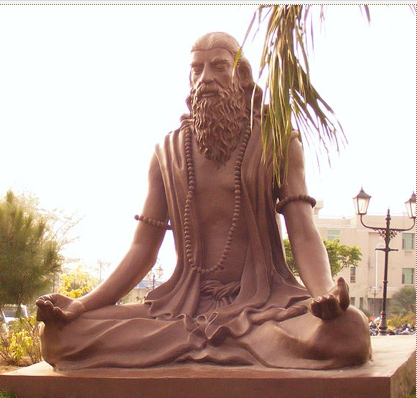
Statue of Patanjali, Haridwar, India
In the Vedanta, there are usually four classifications of consciousness: dreamless sleep, dream sleep, ordinary consciousness, and a fourth transcendental state (divided, perhaps, into varying subtle sub-states). In his yoga sutras, the ancient sage and grammarian, Patanjali, explores the three ordinary states of consciousness and how to attain, though progressively disciplining the thought waves of the mind, the fourth, transcendental state of consciousness.

In his book, "Relativity, Philosophy and Mind," the philosopher and polymath spiritual seeker, Paul Brunton, commented on these differing states of consciousness, noting:
Paul Brunton (1898-1982)
"A man never leaves Consciousness. The world comes into it as perception, that is as idea. Whether anything, object or state, comes into it or not, consciousness remains as his unchanging home. Whether asleep or awake, wrapped in himself or out in the world, his essential being remains what it is. His thoughts and sense-impressions, feelings and passions are produced by it or projected from it: they exist in dependence on it and die in it."

"(E)ven deep sleep unconsciousness is a form of this "consciousness" which transcends all the states we ordinarily know - waking, dream and deep sleep - yet includes them when they merge back into it. Such a "consciousness" is unthinkable, unimaginable, but it is the true objective awareness. It is also the I you are seeking so much. But to reach it, then you have to let go of the I which you know so well."
["The Notebooks of Paul Brunton," vol. 13, para 183-184]
In the video embedded below, Paramahansa Nithyananada comments on the classical yoga teachings of Patanjali, 2,000 year old teachings that deal extensively with the four states of consciousness in setting out the yoga techniques which are required to reach the fourth transcendental state. The problem for the vast majority of people, however, Nithyananda notes, is that even in our waking state we are prone to be absent-minded or "dreaming."

Paramahansa Nithyananda
"The whole of humanity is sleep walking, except the man who is awakened, the man who is enlightened," says Paramahansa Nethyananda in his explanation of Patanjali's yoga sutras. "Being absent-minded, not being alive in the state in which you are is what I call 'sleep.' . . . Otherwise (for) all problems you face, you have a solution."

"There is no problem which cannot be solved," he notes. "All problems can be completely solved with only one thing: You need to be available. . . . All problems are created when you are not available. When you are not available you mess up the whole thing."

"Because of absent-mindedness people miss many things," says Nithyananda, "their relationships, their life, their positions. Many things get missed. (Being) absent-mindedness during talking with others, or during your your activities, you will lose your worries. (Being) absent-mindedness during your inner planning, inner visualization, inner thinking, (we) understand is the worst one. You will miss some (important) links."

If you are "absent -mindedness in your outer world," he observes, "you lose only things of the outer world. . . . But forgetting to keep your (inner) thoughts, you lose the things that you really need in your life. You lose too many big things."


Friday, April 22, 2011

Andrew Cohen and Rupert Sheldrake: Is Evoution Sacred?

In a thought-provoking dialogue (below) between spiritual teacher Andrew Cohen and the innovative biologist Rupert Sheldrake, two voices from the leading-edge of our post-modern culture discuss whether evolution, itself, may perhaps be sacred.

Noted biologist and author,
Dr. Rupert Sheldrake.
"We can become aware of our connection to the cosmos and this vast evolutionary process," says Sheldrake," but the question is: 'Where is it going?' Does it just go ever and onwards and upwards forever until we get more and more enlightened and more and more cosmically aware? Or, does there come a point where there is some kind of a culmination of the whole cosmic evolutionary process?"

Noting that the Judeo-Christian tradition, which gave us "the vision of a progressive evolution in time," always had an explicit goal in the future, Sheldrake asks Cohen (a proponent of the teaching he calls "evolutionary enlightenment") what an 'end-state' to the evolutionary process would be.

In observing that it is a "big picture" answer that frankly verges on "the realm of fantasy," Cohen notes that the "direction or the 'teleos' of the evolutionary process is towards consciousness itself."

Spiritual teacher, Andrew Cohen,
Editor-in-Chief of EnlightenNext
magazine.
Cohen posits that, "it would seem that the urge towards consciousness would be fulfilled, or would be ultimately completed, when all the matter in the cosmos had become enlightened - which means conscious. When all the matter in the cosmos had become fully enlightened," he observes, "we would say that the primary urge - if that's what it is - would be vanquished, that it would be fulfilled."

Noting that the process has "barely begun," Cohen  observes that we are at the very beginning of a process that is of such infinite proportions that it is nearly impossible to conceive. Nevertheless,  he calls this "urge to become conscious" our primary driving motivation.

For his part, Sheldrake - an innovative biologist who is noted for his theory of 'morphic fields' - observes that "there is already a large degree of consciousness throughout the  universe, and perhaps that extra awareness comes from us, rather than somehow by our own conscious development we are going to inject consciousness into the rest of the universe."

Their discussion is a fascinating leading-edge discussion of concepts that have long been an integral aspect of the ultimate teachings of both Mahayana Buddhism and the Advaita Vedanta, as two of the most innovative contemporary minds approach what may be thought of as "the biggest question" from two very different directions . . . and nonetheless come to agreement.

"When consciousness awakens to itself, Cohen concludes, "that's when everything comes alive." A point which is acceded whole-heartedly by Sheldrake.

Sunday, April 17, 2011

Quantum Physics, Consciousness and the 'Ground of Being'

Dr. Amit Goswami, director of the
Centre for Quantum Activism
, board
member of the Institute of Noetic Sciences.

Anyone who has seen the thought-provoking film, "What the Bleep Do We Know!?" will instantly recognize Dr. Amit Goswami, who is featured throughout the film. Dr. Goswami "is a theoretical nuclear physicist and a member of The University of Oregon Institute for Theoretical Physics since 1968, teaching physics for 32 years," before recently retiring. (He is currently a director of the Centre for Quantum Activism, and sits on the advisory board to the Institute of Noetic Sciences.)

"After a period of distress and frustration in his private and professional life starting at the age 38, his research interests shifted to quantum cosmology, quantum measurement theory, and," perhaps most famously, "applications of quantum mechanics to the mind-body problem." [Source: Wikipedia]

In a three-part interview on the interrelationship of quantum physics and consciousness, Dr. Goswami notes that quantum physics is "giving us a new world view that shows clearly how consciousness can be, and is, the ground of our being."

"Quantum physics," says Dr. Goswami, "enables us to see directly that we can make sense of the world only if we base the world on consciousness. (The) world is made of consciousness; (the) world is consciousness; (and) consciousness is the ground of being." (Note the deliberate and repeated use of the term 'ground of being,' a term in use for millennia in the Vedanta tradition as a descriptor of Brahma, or, in Western conventional terms, God.)

"Quantum mathematics, which in our belief is the most fundamental mathematics, the most accurate mathematical description of nature, that we have discovered," continues Goswami, "says clearly that the movement of objects are describable only in terms of possibilities, not the actual events that happen in our experience."

"If we accept this," he says, "then the question immediately becomes who, (or) what chooses amongst these possibilities to bring the actual event (into) experience. So we directly, immediately, see that consciousness must be involved. The observer cannot be ignored.  The observer is part of the description of the world."

But since we cannot explain, and quantum mathematics does not include a description of the observer, Dr. Goswami concludes, "we get the idea that the subject must be more fundamental than the objects; (that) consciousness is more fundamental; (that) consciousness must be the ground of being of which objects are part, but not all of it."


Friday, March 4, 2011

The Purified Mind Is Like the Clear Waters of a Placid Lake

Perhaps the most influential book that I've read in my life (in a three-way "photo finish" tie with Eckhart Tolle's "The Power of Now" and Eric Butterworth's "Discover the Power Within You") is "How To Know God" - a translation and commentary on Patanjali's Yoga Aphorisms by Christopher Isherwood and Swami Prabhavananda, a founder of the Vedanta Society of Southern California. (My first teacher called it his "Book of Soul Realization.")

Yoga (or, the practice of reuniting our consciousness with the deeper consciousness of the Godhead), it explains, is "the control of thought-waves in the mind." The methodologies of all the branches of Yoga, even the now-popular hatha yoga, are ultimately aimed at achieving this reunion.

"The mind seems to be intelligent and conscious," Isherwood and Prabhavananda note. And, yet, "Yoga philosophy teaches that it is not." Our ordinary mind - self-consciousness, or the "ego" - in fact, "borrows" its seeming consciousness and intelligence from the Godhead within us, from the Atman.

In a powerful image, Isherwood and Prabhavananda explain how the true nature of the mind (the Atman) is obscured by our habitual ideas and patterns of thought (the samskaras, or 'sheaths' that obscure the Atman) and how spiritual practice and meditation clarifies the mind and reunites it with the Godhead within each of us. They, as many traditionalist teachers before them have done, compare the mind to a lake.
"If the surface of a lake is lashed into waves, the water becomes muddy and the bottom cannot be seen. The lake represents the mind and the bottom of the lake represents the Atman.


When Patanjali speaks of "control of thought-waves," he does not refer to a momentary or superficial control. . . . We have to do something much more difficult - to unlearn the identification of the thought-waves with the ego-sense. This process of unlearning involves a complete transformation of character, a "renewal of the mind," as St. Paul puts it.
 . . . Waves do not merely disturb the surface of the water, they also, by their continued action, build up banks of sand or pebbles on the lake bottom. Such sandbanks are, of course, much more permanent and solid than the waves themselves. They may be compared to the tendencies, potentialities and latent states that exist in the conscious and unconscious areas of the mind. In Sanskrit, they are called samskaras. The samskaras are built up by the continued actions of the thought-waves, and they, in their turn, create new thought-waves - the process works both ways. . . . The sum total of our samskaras is, in fact, our character - at any given time. Let us never forget, however, that, just as a sandbank may shift and change its shape if the tide or the current changes, so also the samskaras may be modified by the introduction of other kinds of thought-waves into the mind."
Sri Satchidananda
As another commentator, Sri Swami Satchidananda, notes in his commentary on Patanjali ("The Yoga Sutras of Patanjali"), all the rest of Patanjali's aphorisms are merely a riff on how and by what methods we become able to control the thought-waves of the mind, as well as the results that such discipline brings to us - moksha, liberation, or as it is known in the West, enlightenment.

"The yoga aspirant does not waste his time wondering where his samskaras come from or how long he has had them; he accepts full responsibility for them and sets about trying to change them."
       - Isherwood and Prabhavananda, page 21.

Thursday, January 6, 2011

Human Existence Is "Trifarious" . . . Consisting of Body, Mind and Spirit

Writing in The Times of India - an excellent source for spiritual aspirants, as  one of India's top daily newspapers features reports on India's spiritual heritage - Shri Shri Anandamurti makes the following observations on humamankind's true nature:

Human existence is trifarious, a combination of three currents: physical, mental and spiritual. Most people may not transcend the limits of their physical existence: they get enmeshed in crude worldly pleasures, tormented by desire. Subtleties of life, expression and practice are perhaps beyond their reach. Their world is limited to their bodies and physical requirements.

There are others who are more concerned with their minds as they feel that it is the supremacy of mind that sets them apart. Their lives are guided by their desires for mental satisfaction. By virtue of their endeavours they create poetry, art, music and sculpture, for instance. They express the finer human feelings of mercy, sympathy, love, friendship and pity. They believe that the mind flows for the sole purpose of attaining the Infinite, and hence they focus their energies on the contemplation of the Transcendental Entity. They are spiritual aspirants. Drawn by the magnetic attraction of Cosmic Consciousness they speed forward and reach the stage which marks the end of mental existence and the beginning of spirituality. At that stage one is no longer a human being, one is a veritable god.
Clearly drawing from India's Vedantist heritage - perhaps the true source of most, if not all, of the spiritual traditions - at a deep level, Anandamurti's comprehensive comments encompass Christianity's "trinitarian" nature of God, and idealized Man.

The entire article is worthy of review for its observations of how cultures and societies in this phase of their evolution have lost their focus on mental and spiritual accomplishments - and, thus, their 'humanity' - in the pursuit of physical comforts and stimulation.