Showing posts with label enlightenment. Show all posts

Friday, October 5, 2012

The 'Normalcy' of Suffering

"The outer world of circumstance shapes itself to the inner world of thought, and both pleasant and unpleasant external conditions are factors, which make for the ultimate good of the individual. As the reaper of his own harvest, man learns both by suffering and bliss."
-- James Allen, "As a Man Thinketh"
Suffering, the Buddha said, is the normal, unenlightened condition of all sentient beings. That our ordinary self-consciousness is a state of suffering, that there are specific causes of such suffering, that there is the possibility of ending suffering, and that there is a path which can lead to the end this suffering and the bliss of nirvana are the Four Noble Truths, the essence of all Buddhist teachings. Indeed, the idea that facing and overcoming one's passions - i.e., one's suffering - leads to the 'salvation' of a wider and deeper consciousness is a lesson that can be found in virtually all of the world's great religious and wisdom traditions.

 * * * * * * * * * * * * * 

“Sometimes we must undergo hardships, breakups, and narcissistic wounds, which shatter the flattering image that we had of ourselves, in order to discover two truths: that we are not who we thought we were; and that the loss of a cherished pleasure is not necessarily the loss of true happiness and well-being.”
― Jean-Yves Leloup

“There is a light in this world, a healing spirit more powerful than any darkness we may encounter. We sometimes lose sight of this force when there is suffering, too much pain. Then suddenly, the spirit will emerge through the lives of ordinary people who hear a call and answer in extraordinary ways.”
― Mother Teresa

“No pain that we suffer, no trial that we experience is wasted. It ministers to our education, to the development of such qualities as patience, faith, fortitude and humility. All that we suffer and all that we endure, especially when we endure it patiently, builds up our characters, purifies our hearts, expands our souls, and makes us more tender and charitable, more worthy to be called the children of God . . . and it is through sorrow and suffering, toil and tribulation, that we gain the education that we come here to acquire and which will make us more like our Father and Mother in heaven.”
― Orson F. Whitney

“As long as you think that the cause of your problem is “out there”—as long as you think that anyone or anything is responsible for your suffering—the situation is hopeless. It means that you are forever in the role of victim, that you’re suffering in paradise.”
― Byron Katie

“The wound is the place where the Light enters you.”
― Rumi

Thursday, September 22, 2011

Mooji: On the Conquest of Thought

"If we think for a moment that there is such a thing as thought, consciousness itself will appear as thought. That itself will appear as the world, and jivas, and as the Supreme. There will be misery arising out of it. Therefore, beloved, conquer thought easily by the certitude that there is no such thing as thought and all is Consciousness, and like this attain bliss."

"Conquest of thought alone is the great success. Conquest of thought alone is the great achievement. Conquest of thought alone is the great yoga. Conquest of thought alone is the great knowledge. Conquest of thought alone is the great purification. Conquest of thought alone is the great liberation. Conquest of thought alone is the removal of sorrow. Conquest of thought alone is the greatest happiness. But conquest of thought is, itself, the renunciation of thought, (and) the renunciation of thought is Consciousness."


-- Ribhu Gita --

Anthony Paul ("Mooji") Moo-Young
Basing his short lecture (below) on a reading from the Ribbhu Gita, spiritual teacher, Mooji, points out that the basic problem of human existence, the individual ego, arises from the individual's identification with the body-mind complex rather than the pure Being innate in each of us. Mahamaya, the great illusion that we are the body-mind and nothing more, arises when we wholly identify with our egoic thinking, and are thus blinded to the pure consciousness and Being within us.
"Egoic thought can only molest you when you are the body-mind identity," Mooji notes. "Mahamaya, the great illusion, can only overwhelm you when you carry the modification 'I am the body-mind', 'I am just a person.' No person can defeat that Mahamaya. It is only because the Parabrahman is inside you, the Supreme Being is inside you, that you can transcend maya.""

"(It is) only by limiting yourself to being the body-mind only," Mooji points out, that illusions and (more) illusions can enter. But because the Supreme Being is your Being, because you are identical with that, and that alone can transcend the effects of maya, that is the evidence that you are the Supreme Being. Because human beings have transcended maya."
"Nothing is either good or bad," wrote Shakespeare, "But our thinking makes it so."


Thursday, July 14, 2011

Neti, Neti: Language from Beyond the Self

"The quicker you are in attaching verbal or mental labels to things, people, or situations, the more shallow and lifeless your becomes, and the more deadened you become to reality, the miracle of life that continuously unfolds within and around you. In this way, cleverness may be gained, but wisdom is lost, and so are joy, love, creativity, and aliveness. They are concealed in the still gap between perception and the interpretation. Of course we have to use words and thoughts. They have their own beauty - but do we need to be imprisoned by them."

The great existential battle is to rise above self-consciousness, and to rid our being of the constant, conditioned inner narrative of the ego. It is this undammed "stream of consciousness" that carries us through an entire lifetime unaware that our real being lies beyond words.

 "Neti, neti, neti," goes the Sanskrit chant. "Not this, not this, not this." How, after all, can words possibly describe the ineffable? Spiritual teachers have always taught that the Ultimate is beyond description, and that the incessant voice of the ego is what separates us from the divine. Even when we voice the words in our mind that describe the Ultimate, our words pass like a net through barren waters - catching nothing. "Not this, not this, not this," we realize.
"Knowledge born of the intellect am I not. By nature Truth eternal am I. I am perpetual immutability. Neither formless nor with form, described by the Vedas as "Not this, not this," free from separation and unity, the true Self reigns supreme."
-- Avadhut Gita I:49-50 --
"When the ocean is searching for you," Rumi says, "don't walk to the language-river. Listen to the ocean, and bring your talky business to an end."


"There is a way between voice and presence
where information flows.

In disciplined silence it opens.
With wandering talk it closes."
-- "The Essential Rumi" --
(Translations by Coleman Barks)

Friday, July 8, 2011

Gurdjieff and Heightened Consciousness

"It is only when we realize that life is taking us nowhere that it begins to have meaning."
-- P. D. Ouspensky --
In the attached video, the Rev. Theodore (Ted) Nottingham examines the "Fourth Way" teachings of G. I. Gurdjieff, an enigmatic yet enlightened teacher who burst onto the spiritual scene in the first half of the twentieth-century. Gurdjieff's teachings express the truths found in ancient religious and wisdom teachings relating to self-awareness in people's daily lives, and are as current and relevant today (if not more so) as they were when Gurdjieff and his many students (including P.D. Ouspensky) formed various wisdom schools to pass on his esoteric teachings.

"The idea that we are not awake but live in a partial dream state from which we can awaken opens on to radically new horizons," Nottingham observes. "The illusions we foster concerning ourselves melt in the light of increased consciousness, and we awaken to new dimensions of reality that set us free. We are then able to relate to the world around us without our usual defenses, and masks, and confusion, which constitute so much of human interaction. We also become capable of a new kind of compassion."

"Ultimately," he notes, "this third state of consciousness which is our birthright (i.e., heightened consciousness beyond sleep and ordinary wakefulness) frees us from the unnecessary agonies of a little ego always struggling for self-importance and gratification, and awakens us to new insight and understanding. The world becomes a different place and we become far more than our imaginary 'selves' ever dreamt of. The potential for happiness, fulfillment and genuine usefulness to humanity are now tangible realities."

"This use of attention," he points out, "is similar to the 'Watch of the Heart' of early Eastern Christian spirituality and the remembrance of God of the Sufi mystics. To be aware of a higher reality while dealing with ordinary reality requires an effort of awareness, detachment and concentration that is the result of long practice."


Wednesday, July 6, 2011

Carl Jung and Gerald Heard: Instinct, Evolution and the Enlargement of Consciousness

"Nothing estranges man more from the ground plan of his instincts than his learning capacity, which turns out to be a genuine drive towards progressive transformations of human modes of behavior. It, more than anything else, is responsible for the altered conditions of our existence and the need for new adaptations which civilization brings. It is also the source of numerous psychic disturbances and difficulties occasioned by man's progressive alienation from his instinctual foundation, i.e., by his uprootedness and identification with his conscious knowledge of himself, by his concern with consciousness at the expense of the unconscious."

"The result is that modern man can know himself only in so far as he can become conscious of himself - a capacity largely dependent on environmental conditions, the drive for knowledge and control of which necessitated or suggested certain modifications of his original instinctive tendencies. His consciousness therefore orients itself chiefly by observing and investigating him, and it is to its peculiarities that he must adapt his psychic and technical resource."

"This task is so exacting, and its fulfillment so advantageous, that he forgets himself in the process, losing sight of his instinctual nature and putting his own conceptions of himself in place of his real being. In this way he slips imperceptibly into a purely conceptual world where the products of his conscious activity progressively replace reality."

-- Carl Jung --
("The Undiscovered Self")
Gerald Heard
(1889-1971)
In his magnus opus, first published in 1939, "Pain, Sex and Time," philosopher Gerald Heard traces the evolution of man's consciousness, and the attempts he has made to evolve or dilate consciousness beyond the ordinary and limited  self-consciousness of the human ego, to a higher acceptive consciousness that is, Heard asserts, mankind's evolutionary imperative.

Yet, as this next evolutionary step will necessarily be psychological rather than physical, Heard points out that a conscious effort is needed to evolve consciousness beyond the current self-conscious state typical of the species in this epoch. Historically, he notes, pointing to past efforts to raise consciousness, this has been the exclusive domain of esoteric teachings and mystery schools. In reading his account of the historical attempts that were made to evolve consciously, one wonders, how Heard (who passed away in 1971) would interpret the widespread interest in conscious evolution that has been exhibited at the dawn of the twenty-first century.

. . . . . . . . . . . . .

In reading Heard, one is struck by the similarities of views he shared with Jung. But while Jung asserts that "modern man can know himself only in so far as he can become conscious of himself," Heard notes that a much greater effort is required to achieve a far greater result.

"If we are to advance through the evolution of consciousness beyond self-consciousness," he observes, "to reunite consciousness now divided into the self-conscious and the sub-conscious, and so bring about a new and single quality of awareness and being, there is required of us a peculiar and rare quality of attention. It must be intense but without effort and strain. It must be that over-plus of evolutionary energy which we call curiosity, and the German tongue calls Neugier, the new appetite, raised to what Plato called illuminating wonder."

"Indeed," he notes, "because we are now so deeply prejudiced in favour of the assumption that it is only possible for one real experience to be presented to us, and that can only be the world of common sense, the necessary state of mind required for enlargement of consciousness must be one which is even without expectation."

"We are waiting," he points out, "for an experience of which we have no conception from the past, and that being so, any clear expectation must distort or even completely inhibit a radically new awareness."

Thursday, June 23, 2011

Non-Attachment: From Meditation to Samadhi

Non-attachment to the perceptions of the world - non-attachment to our ideas of its people, places, things and situations - is an essential component of spiritual practice, irrespective of religious tradition. "In the end what matters most," reads a banner in my living room, "is how well did you live, how well did you love, how well did you learn to let go." Poignant words, for one day we all have to let go of everything, and all that will attest to our being here this time around, is how well we lived our lives and how well we loved the beings we encountered.

In his enlightening book, "How to Know God: The Yoga Aphorisms of Patanjali" (written with Christopher Isherwood), Swami Prabhavananda notes that "(i)f we try to concentrate (in meditation) while remaining attached to the things of this world, we shall fail altogether or our newly acquired powers of concentration will bring us into great danger, because we shall inevitably use them for selfish, unspiritual ends." (He points to the violent excesses of the twentieth-century as evidence of what happens when man concentrates on science "without unlearning his attachment to nationalistic power.")

But how, then, are we to learn such detachment from the ego and its desires for the objects and ambitions that the world presents? "We must begin," says Prabhavananda, "by cultivating attachment to the highest object we can conceive of, to God himself."

First, he suggests, concentrate upon a spiritual ideal - Christ, Krishna, the Buddha, or his own teacher, Ramakrishna - and as attachment to that ideal is generated, lesser attachments to the people, places and things of the world slip away. This, Prabhavananda says, effects non-attachment at the level "of gross phenomena."

Next, Prabhavananda suggests, as meditation and contemplation on our ideal progresses, we lose attachment to the ideal as we gain understanding to the spirit within him or her. At that stage, he observes, we move "from the level of gross phenomena to the subtle or spiritual level." At this point, "(w)e shall no longer admire a Christ or a Ramakrishna as human beings within time, but we shall worship them as eternal, spiritual beings. We shall know them in their divine aspect."

From there, says Prabhavananda, there is a third stage, or "third level of consciousness" that transcends even attachment to these subtle forms. "For behind Christ," he points out, "behind Ramakrishna, behind any conception of a personal God, there is Brahman, the Ground, the central Reality of which these figures are only partial, individual projections."

"When we become united with Brahman," Prabhavananda notes, "we are united with That which was manifested in Christ and hidden within our unregenerate selves, but which is eternally present in all of us. And this union is the state of nirvikalpa samadhi."

In describing just what nirvikalpa samadhi is, Prabhavananda leans on the following description by the great seventh-century Vedantist teacher, Shankara:
"There is a continuous consciousness of the unity of Atman and Brahman. There is no longer any identification of the Atman with its coverings. All sense of duality is obliterated. There is pure, unified consciousness. The man who is well established in this consciousness is said to be illumined."

"A man is said to be free even in this life when he is established in illumination. His bliss is unending. He almost forgets this world of appearances.

"Even though his mind is dissolved in Brahman, he is fully awake, free from the ignorance of waking life. He is fully conscious, but free from any craving. Such a man is said to be free even in this life."

"For him, the sorrows of this world are over. Though he possesses a finite body, he remains unitied with the Infinite. His heart knows no anxiety. Such a man is said to be free even in this life."
Thus, beyond the attachments of the ego to the things of the world, there lies available to us a higher consciousness in which may be found the "peace that surpasseth all understanding."  (Phillipians 4:7)

Wednesday, June 22, 2011

Exodus: The Journey from Ego to Transcendental Consciousness

"A traveler in ancient Greece had lost his way and, seeking to find it, asked directions of a man by the roadside who turned out to be Socrates. "How can I reach Mt. Olympus?" asked the traveler. To this Socrates is said to have replied, "Just make every step you take go in that direction."
[Eric Butterworth, "Discover the Power Within You," page 15.]
"Egypt and the Pharoah are very real," observed Chassidic rabbi, Tzi Freeman. "Either you are doing Exodus, or you are dong slavery." Exodus, or the journey to Mt. Olympus, are, of course, metaphors for the moment-by-moment quest for enlightenment and freedom from ego-consciousness. Enlightenment, moksha, personal liberation, salvation - however you wish to describe that rarefied spiritual state of higher consciousness - is an all-or-nothing deal.

As spiritual teacher Andrew Cohen has pointed out, enlightenment and ego-consciousness are two parallel tracks, they never intersect. One either experiences the quietude of the enlightened state of Being (what Cohen calls "the Authentic Self"), or one experiences the raucous inner narrative of the small, conditioned "self," or "ego."

"It is probably true," Butterworth observed, "that every man intuitively knows that there is a highway of right living and that he is never completely satisfied with himself or his world until he finds the road to his own "Mt. Olympus." And it may be that this distinction leads to the indefinable yearning and hunger and thirst that causes the excesses that plague mankind. He feels the inner urge but he usually moves in the wrong direction to fill it."

Indeed, as the Apostle Paul acknowledged in his letter to the Romans:
"I do not understand what I do. For what I want to do I do not do, but what I hate I do. And if I do what I do not want to do, I agree that the law is good. As it is, it is no longer I myself who do it, but it is sin living in me. For I know that good itself does not dwell in me, that is, in my sinful nature. For I have the desire to do what is good, but I cannot carry it out. For I do not do the good I want to do, but the evil I do not want to do—this I keep on doing."
[Romans 7:15-19]
The great Swiss psychologist, Carl Jung, recognized this spiritual need and acknowledged how, if misdirected, it can lead the unsuspecting man or woman deeper into the bondage of the ego. In a letter to Bill Wilson, the co-founder of Alcoholics Anonymous, he observed:
"I am strongly convinced that the evil principle prevailing in this world leads the unrecognized spiritual need into perdition, if it is not counteracted either by real religious insight or by the protective wall of human community. An ordinary man, not protected by an action from above and isolated in society, cannot resist the power of evil, which is called very aptly the Devil. But the use of such words arouses so many mistakes that one can only keep aloof from them as much as possible."
However, in his pithy, but all-important work, "The Undiscovered Self," in which he strongly critiques the development of the modern State, Jung convincingly makes the case that even society, as we have come to know it, is not in itself sufficient to meet mankind's hidden spiritual needs. In fact, it is just the opposite.
"Just as man, as a social being, cannot in the long run exist without a tie to the community," Jung observes, "so the individual will never find the real justification for his existence, and his own spiritual and moral autonomy, anywhere except in an extramundane principle capable of relativizing the overpowering influence of external factors."

"The individual who is not anchored in God," Jung points out, "can offer no resistance on his own resources to the physical and moral blandishments of the world."

"For this," Jung notes, "he needs the inner, transcendent experience which alone can protect him from the otherwise inevitable submersion in the mass. Merely intellectual or even moral insight into the stultification and moral irresponsibility of the mass man is a negative recognition only and amounts to not much more than a wavering on the road to the atomization of the individual. It lacks the driving force of religious conviction, since it is merely rational."
[Jung, "The Undiscovered Self," page 34.]
How then is the individual to achieve such an inner, transcendent experience? Clearly, as Jung suggests, it cannot be achieved through rational thought. What is needed first, perhaps, is the knowledge that such a transcendent experience is available to all, and then after that a conscious decision to make each of his or her steps go towards the Mt. Olympus of higher, non-egoic consciousness.

Monday, June 20, 2011

Doing One's Dharma and Finding One's Path

There are innumerable paths to enlightenment - or, perhaps more accurately, the number of paths to enlightenment is precisely equal to those beings who consciously seek that goal - for each of us approaches the goal of liberation from where we are, by working out our karma, by following our own personal dharma, by walking lightly on the Earth and leaving small footprints.

Unlike traditional Indian society with its castes and classes, and with its four stages of life (the student, the householder, the spiritual aspirant, and the renunciate), modern society - East and West - no longer holds tightly to such rigid distinctions, and everyone must come to understand and work out their particular avenue through life and towards personal liberation.

"In his study of the Bhagavad Gita ("Paths to God"), iconic spiritual teacher Ram Dass notes that "(t)here are very few clear, cultural prescriptions that are deeply ingrained in our society to tell us what to do. So we're faced with having to figure out for ourselves what our dharma might be."
"We have to rely on ourselves," he points out, "we have to listen and hear how our individual differences will determine our appropriate duty moment by moment. All of our circumstances feed into that: If you have a certain type of intellect, of if you have certain economic circumstances, it defines certain paths. If you have a husband or a wife, that defines certain possibilities, and it also defines certain limiting conditions."

"Some people," he observes, "might say, "I can only do a job that is absolutely dharmic, and I would rather starve to death than earn money impurely." Others say, "Look - I'll do the best I can, given my circumstances." There's no judgment in either case; each of us has to hear what each of us has do to."

"If you are a sadhu, if you are single and a renunciate, then maybe you can afford to be more of a purist," he points out, "(as) no one is dependent on you. On the other hand," he points out, "if you are a householder and have a family, then you have certain responsibilities, and you've got to do the best you can. If you are a householder, but you are being such a purist that you don't get enough money to feed your baby, in the long run you will have done more adharma than dharma. If you're in that situation and you find that you have to take a job that doesn't feel entirely dharmic to you, do the best you can to bring as much consciousness as possible into the scene. That's all you can do. You work with what you are given."
"You do that with respect to each aspect of your life," Dass notes. "Whatever your part is," he says," you just play it, but you play it as consciously as you can. That's the most basic form of the concept of doing your dharma: to find your little square on the grid, and then to live it out perfectly."


Monday, June 13, 2011

Bliss, Peace and the 'Kingdom of God' Within You

"The undisturbed state of being is bliss; the disturbed state is what appears as the world. In non-duality there is bliss; in duality - experience. What comes and goes is experience with the duality of pain and pleasure. Bliss is not to be known. One is always bliss, but never blissful. Bliss is not an attitude."
-- Sri Nisargadatta --
Sri Nisargadatta
(1897-1981)
One cannot "think" blissfully. As the enlightened teacher Sir Nisargadatta observed: "Bliss is not an attitude." It is not a way of thinking. Bliss is the natural state of our being, devoid of ego or the sense of a small "self" as the identity of 'who' and 'what' we are.

When finally confronted directly by the Pharisees who demanded to be shown "where" the "kingdom of God" might be found, Jesus (who always couched his public teachings in parables) replied:
"The kingdom of God cometh not with observation: Neither shall they say, Lo here! or, lo there! for, behold, the kingdom of God is within you."
[Luke 17:20-21]
The state of enlightenment, thus seems to be an inner state of consciousness and being and not a system, attitude or way of thinking. "Peace," Kahlil Gibran observed, "is an oasis in the heart that can never be reached by the caravan of thinking." It is thus, incumbent upon the true spiritual seeker to go deeply within him or herself if the blissful state of pure Being is to be found. It is, as Nisargadatta observes, beyond the duality of the world which is created by the small "self" of the ego, and its egoic mode of thinking.

Interestingly, however, when this state of inner Bliss is achieved, it seems to change one's realization of what the world and its outer forms are. Thus, in the Gospel of Thomas (which has been continually used by the Coptic, Syriac and Nestorian, but not the Catholic or Orthodox churches) Jesus' confrontation with the Pharisees is echoed. This time, however, in response to an enquiry from his disciples asking, when the "the kingdom" will come, Jesus answers:
"It will not come by waiting for it. It will not be a matter of saying 'here it is' or 'there it is.' Rather, the kingdom of the father is spread out upon the earth, and men do not see it."
["The Nag Hammadi Library," Gospel of Thomas, verses 113-114.]
Similarly, at the beginning of the Gospel of Thomas, Jesus is reported to have said to Thomas, referred to as Didymos Judas Thomas, in the Nag Hammadi texts (a.k.a., the "Dead Sea scrolls"):
"If those who lead you say to you, 'See, the kingdom is in the sky,' then the birds will precede you. If they say to you, 'It is in the sea,' then the fish will precede you. Rather the kingdom is inside of you, and it is outside of you. When you come to know yourselves, then you will become known, and you will realize that it is you who are the sons of the living father. But if you will not know yourselves, you dwell in poverty and it is you who are that poverty."
 It is only by coming to known one's true "Self," rather than the false, smaller "self" of the ego, that one realizes the bliss state of one's pure Being, and one realizes they are an inseparable component of the Ground of Being, or pure Bliss.

"There are no others to help," says Nisagardatta. "A rich man, when he hands over his entire fortune to his family, has not a coin left to give a beggar. So is the wise man (gnani) stripped of all his powers and possessions. Nothing, literally nothing, can be said about him. He cannot help anybody, for he is everybody. He is the poor and also his poverty, the thief and also his thievery. How can he be said to help, when he is not apart? Who thinks of himself as separate from the world, let him help the world."

"The only thing that can help," says Nisargadatta, " is to wake up from the dream."

"The beginningless begins forever," he notes. "In the same way, I give eternally, because I have nothing. To be nothing, to have nothing, to keep nothing for oneself is the greatest gift, the highest generosity."

"The self is all," Nisargadatta points out. "In practice it takes the shape of goodwill, unfailing and universal. You may call it love, all-pervading, all-redeeming. Such love is supremely active - (but) without the sense of doing." Such, it seems, is the state of Bliss.

Friday, June 10, 2011

Mystics, Awakening and the Divine: A Sufi View

 “… Our birth is but a sleep and a forgetting
The soul that rises with us, our life’s Star,
Hath had elsewhere its setting,
And cometh from afar.
Not in entire forgetfulness,
And not in utter nakedness,
But trailing clouds of glory do we come,
From God who is our home.
”
 -- William Wordsworth --
("Intimations of Immortality from Recollections of Early Childhood.")


"Mystics are lovers going home," writes Sufi teacher and author, Llewellyn Vaughan-Lee, "living the passion and commitment that are needed to surrender and be taken, to become empty of oneself and filled with the Beloved."

"Little can be told," he suggests, "of the innermost mysteries of the heart, of how our own soul opens to God. And for each of us this jouney, our heart's pilgrimage, is unique, because each of us is unique. We are each a unique creation by the Great Artist, and each of us makes our own offering in the fire of love."

"We all come from God," he continues, "but when we are born into this world we forget. We forget from where we have come and that we are children of light. We take on the clothing of the world, leaving behind the "clouds of glory" of our true Home. The Sufi calls this the "journey from God," a journey of forgetfulness in which we leave Paradise behind."

But," Vaughn-Lee observes, "there are those who never quite forget, who keep a distant memory buried deep within them. As a result this world never seems like home; there is often a sense of not quite belonging, not fitting in."

"Mystics," he notes, "are strangers in this world, just because they remember their real home."
["Love is a Firre: The Sufi's Mystical Journey Home," pp. 20-21.]

. . . . . . . . . . . . .

In the following six-part video lecture, Vaughan Lee examines spiritual awakening, who and what it is that awakens, and what they awaken to.


Tuesday, June 7, 2011

Emptiness and Dependent Origination: "Truth That Sets You Free"

"Emptiness," "insubstantiality" and "co-dependent origination" are fundamental concepts in Mahayana Buddhism, yet these concepts are also recognized realities in Daoist teachings, the teachings of many Indian philosophical and yoga schools, and - though not specifically referenced - most of the world's great wisdom traditions.

What we know of the origination and vast emptiness of the universe, as well as the mechanics and profound emptiness of the atom, makes these ancient philosophical realizations particularly relevant to all of us, although the Western worldview, to a large extent, still clings to its traditional materialist view of man, mind, the world and the cosmos.

In Chapter II of the Dao De Jing, we read:

"The thirty spokes converge at one hub,
But the utility of the cart is a function of the nothingness inside the hub.
We throw clay to shape a pot,
But the utility of the clay pot is a function of the nothingness inside it.
We bore out doors and windows to make a dwelling,
But the utility of the dwelling is a function of the nothingness inside it.
Thus, it might be something that provides the value,
But it is nothing that provides the utility."

[Ames and Hall, "Dao De Jin: A Philosophical Translation, page 91.]

"There is nothing," said Tzu-ch'i, "that is not a 'that' and nothing that is not a 'this.' One does not see from the standpoint of another knowing by oneself is knowing something. Therefore it is said: ''That' comes from 'this,' and 'this' is based on 'that.' This explains how 'that' and 'this' arise simultaneously."

"But when there is arising," he continued, "there is passing away; and when there is passing away, there is arising. When there is right, there is wrong; when there is wrong, there is right. By affirming we deny; by denying we affirm."

"Therefore," he notes, "sages do not go this way but perceive it in the context of nature. This is also based on an affirmation."

"A 'this' is also a 'that,' and a 'that' is also a 'this,' he concludes. "'That' is one judgment, and 'this' is also one judgment. Ultimately, are there in fact 'that' and 'this,' or are there no 'that' or 'this'? Nothing can be opposite to 'that and this' - we call this fact the pivot of the Way. When the pivot is centered in its hub, thereby responding infinitely, then affirmation is one infinity and negation is also one infinity."
[Clearey, "The Essential Tao," page 72.]

Vedantists, and other Indian philosophical and yoga schools, label this concept of "this and that,' or 'neither this nor that,' "sunyata" - a transcendental  state in which neither 'this' nor 'that' exists absolutely. In "The Spiritual Heritage of India," Vedantist scholar, Swami Prabhavananda, suggests that these concepts extend to all the world's great wisdom traditions, including Christianity, and that the transcendental reality in which this is experienced can be attained by all.
"The nirvana of Buddha," writes Prabhavananada, "is . . . not a state of annihilation but the attainment of the unchangeable reality, which can be positively described as the eternal peace. But what this peace really is, no words can define; all definition can be only symbol and can offer only a vague suggestion. Buddha employs negative terms for its description, such as freedom from misery and death, freedom from sensuality, from the ego, from delusion, from ignorance."

"This state of freedom is attainable by the 'noble kind of wisdom' - a phrase already quoted from the Buddhist scripture and signifying what the Vedanta calls transcendental knowledge. The wisdom meant is not a wisdom of the intellect, which implies a knower and an object, but rather a state, sunyata, in which no subject-object relation exists, and in which one transcends both intellect and mind - these two words representing, in Hindu psychology, separate entities."

"Christ refers directly to this transcendental wisdom when he says: 'And ye shall know the truth and the truth shall set you free.' It is identical with perfection, the same perfection that Christ has in mind when he says: 'Be ye therefore perfect, even as your Father which is in heaven is perfect.' It is, in brief, the direct, immediate knowledge of that which is timeless unconditional existence."

"The 'noble kind of wisdom' is attainable by 'the noble conduct of life' and 'the noble earnestness of meditation.'"
[Swami Prabhavananda, "The Spiritual Heritage of India," page 186.]

Wednesday, June 1, 2011

Enlightenment: The Tao of Now

"(A)wakening to our original enlightened nature," suggests Robert Holden in the Huffington Post, "involves interrupting the ordinary flow of linear, language-based, thinking so that we can rediscover "the mind within the mind"."

"Focusing on external circumstances or teachings is not what triggers the moment of enlightenment," writes Holden, an author with a decidedly Taoist bent, "(r)ather, it is focusing on the absence of internal commentary. Because it is impossible to "think" without words," he notes, "this practice of stopping the flow of running commentary on our lives involves cultivating a mindset of no-thought (wu-nien) in an attempt to experience each moment as it is without silently talking to ourselves about it."

Holden puts forward the following recollections of nature as doorways into "a wordless space of wonder at the profound transparency of nature," in which, "overwhelmed by awe in the face of creation, the boundaries between self and world dissolve in a mystical union transcending conscious thought."
  •  "A white pelican sails south across the darkening sky, heading deeper into the high desert marshlands."
  • "The first warning drops splash dust on the washboard road as a flock of ibis flap madly against the north wind."
  • "A yellow-headed blackbird throws its head back over its shoulder, singing ecstatically from its perch on a swaying cattail."
  • "The sun blinks through thinning clouds, throwing off a triple rainbow like a casual afterthought."
Each haiku-like observation of the pervasive, yet largely unobserved, face of the world around us, Holden suggests, "offers the perfect opportunity for a higher integration of one's original nature with the eternal Way (Tao) that gives rise to everything from within."

Thoreau's Walden Pond
In "On Man & Nature," the great Transcendentalist, Henry David Thoreau observed: "I want to live ever as to derive my satisfactions and inspirations from the commonest events, every-day phenomena, so that what my senses hourly perceive, my daily walk, the conversation of my neighbors, may inspire me, and I may dream of no heaven but that which lies about me."

"Between Heaven and Earth," says the Tao-Te-Ching, "there seems to be a bellows: It is empty, and yet it is inexhaustible; the more it works, the more comes out of it. No amount of words can fathom it; better look for it within you."
"Paradoxically," writes Holden, "awakening to the perennial truth leads experiencers to see absolute truth and conventional truth as one, not two. This is part of the experience of swallowing the whole of the river in one gulp, wherein all dualities are united within the individual. This grasp of the non-duality of reality and appearance is expressed in the analogy of the statue of a golden lion: its form is that of a lion but its substance is of gold. Because its nature is that of a golden lion, its lion-form cannot be separated from its gold-substance. This analogy hints at the experience of non-duality that lies at the heart of enlightenment, in which the boundaries between self and other, inner and outer, collapse."
"In eternity," observes Thoreau, "there is indeed something true and sublime. But all these times and places and occasions are here and now. God himself culminates in the present moment, and will never be more divine in the lapse of all the ages. And we are enabled to apprehend at all what is sublime and noble only by the perpetual instilling and drenching of the reality that surrounds us."

"Man follows the ways of the Earth," says the Tao-Te-Ching. "The Earth follows the ways of Heaven. Heaven follows the ways of the Tao. Tao follows its own ways."

Monday, May 16, 2011

The Wisdom of a Fool

"To be wise, you must become a fool," is an adage that runs as a substratum through many of the world's great wisdom traditions. In the Islamic tradition, we read the many stories of the seemingly foolish Sufi master, Mullah Nasruddin, and (perhaps) gain great knowledge and insight through his simplicity.

"The Nasruddin stories, known throughout the Middle East, constitute one of the strangest achievements in the history of metaphysics. Superficially, most of the Nasruddin stories may be used as jokes. They are told and retold endlessly in the teahouses and caravanserais, in the homes and on the radio waves, of Asia. But it is inherent in the Nasruddin story that it may be understood at any of many depths. There is the joke, the moral - and the little extra which brings the consciousness of the potential mystic a little further on the way to realization." [Source: www.sysindia.com]

For example:
One day an illiterate man came to Mullah Nasruddin with a letter he had received. "Mullah Nasruddin, please read this letter to me," he asked. Mullah Nasruddin looked at the letter, but could not make out a single word. So he told the ma, "I am sorry, but I cannot read this." The man cried: "For shame, Mullah Nasruddin ! You must be ashamed before the turban you wear (i.e. the sign of education)" Mullah Nasruddin removed the turban from his own head and placed it on the head of the illiterate man, saying: "There, now you wear the turban. If it gives some knowledge, read the letter yourself!"
Or, again:
Mullah Narsuddin was riding his donkey, as always, facing backwards. "Hey, Mullah!," a man called out, "That is the wrong way!" "Enough of this, already!," Narsuddin called back. "The donkey says it wants to go that way. I said I want to go this way. I am letting it go its way, and I am headed in the direction I want to go. Why pick a fight? Why do you object?"
. . . . . . . . . . . . .
"Anyone who thinks himself intelligent because of his scholarly or scientific learning," wrote St. Symeon the New Theologian (one of the most revered of Orthodox Christian saints), "will never be granted insight into divine mysteries unless he first humbles himself and becomes a fool, discarding both his presumption and the knowledge that he has acquired. But if he does this and with unhesitating faith allows himself to be led by those wise in divine matters, he will enter with them into the city of the living God. Guided and illumined by the divine Spirit, he will see and learn what others cannot ever see or learn. He will then be taught by God."
[The Philokalia, Vol. Four, pp. 46-47.]

Sunday, May 8, 2011

Andrew Cohen: "Enlightenment Is a Secret"

Andrew Cohen, Editor-in-chief,
http://www.enlightennext.org/EnlightenNext magazine.
Perhaps the first post-modern spiritual teacher, leading-edge "guru," Andrew Cohen, teaches a brand of radical non-duality he calls "Evolutionary Enlightenment." In doing so, he transcends his roots in the Advaita Vedanta lineage of Ramana Maharshi, and charts a path for our active participation in humanity's evolution and the evolution of the 'kosmos.'

Cohen's vision includes the following five "top-down" tenets for living an awakened life, here and now:

  • Clarity of Intention: One must be 100% committed to the one intention of waking up to the spiritual reality of what and who we are.
  •  The Truth of Impersonality: In a cosmos of 100 billion galaxies and 100s of billions of stars in such galaxies, it is sheer narcissism to focus our consciousness on what we are feeling and thinking from moment to moment; yet that is what the vast majority of us unwittingly do.
  •  Face Everything and Avoid Nothing: To attain enlightenment it is necessary to face, and face down, the fears and desires of the Ego and attain to one's Authentic Self.
  • The Law of Volitionality: We do not do or say anything (or omit doing or saying anything) without a voluntarily intention to do so. All of our actions are of our own volition and, thus, we can no longer foster a 'victim mentality.'
  • For the Sake of the Whole: In a post-modern world, enlightenment for one's own sake is irrelevant; it is only when we attain "autonomy in communion" with others that enlightenment is an effective and true evolutionary tool.

"Realization of the Absolute," writes Cohen, "is the most demanding and all consuming form of meditation that a human being can pursue. . . . Any trace of self-interest of any kind in any form instantly corrupts (the) most perfect purity and automatically, although usually imperceptibility, taints its reflection." ("Enlightenment Is a Secret," p. ix.) Thus, he stresses, one has to get out of the way to let the Absolute manifest:
"There is a secret that is infinitely greater than anything you have ever known. It is real and it exists and if you make room for it - it will overwhelm you.

You have got to get out of the way. You have to abandon everything you've been taught and everything you've been led to believe - all those limiting, confining, imprisoning, denying ideas and concepts that you have picked up along your way. You have to make room for that which is unbelievable. You have to get out of the way. "Oh my God!" you'll say, "I didn't know it could be like this."

If you want to be Free you have to open yourself to the unthinkable possibility. You have to allow yourself to consider that which is immeasurable. You have to rise up. You have to open your mind, open your heart, and renounce the past completely."

[Cohen, "Enlightenment Is a Secret," pp. 12-13.]
In the following video, Cohen describes "Evolutionary Enlightenment" and how it builds upon and surpasses traditional Eastern teachings of personal liberation. In some sense, his teachings of radical transpersonal enlightenment make him, perhaps, the first post-modern Bhoddisatva.

Sunday, May 1, 2011

Tolle and Adyashanti: What is Enlightenment?

The man or woman seeking meaning in their life is bound at some time to hear of enlightenment. But what is enlightenment, really? And where are we to find it? At the feet of a guru? Perhaps? At the top of a mountain? Maybe. In a corner bar, a bottle of pills, a love affair or a new car?  Highly, highly unlikely.

Andrew Cohen, Editor-in-chief,
of EnlightenNext magazine.
The enlightened spiritual teacher, Andrew Cohen, wrote an entire book called "Enlightenment is a Secret." In it, he remarked:
"Enlightenment is a secret that very few people know about and even fewer understand. Why is it a secret? Because Enlightenment does not exist in time. That why it's a secret and that's why it will always be a secret. Enlightenment is a vision that cannot be held or grasped in any way. Beyond this world it's a mystery that is exploding. A fire that is burning. It's a fire that a person is either going to jump into or run away from. This fire burns beyond the mind. No-time is the place where this secret abides. Realize that and you realize the Self you are when there's no mind and no time. Realize that and cling to that alone as your own Self.
The  great Sufi poet and teacher, Rumi, asked us to judge the moth by the worthiness of the candle it immolates itself in. "Enlightenment is not far away," Cohen insists. "It does not need to take time."

Below, two modern enlightened teachers, best-selling author of "The Power of Now," Eckhart Tolle and the neo-Buddhist teacher and author, Adyashanti, tackle the question of just what enlightenment is.

. . . . . . . . . . . . .

Eckhart Tolle
Enlightenment, or the egoless state, "cannot be achieved in the future, or in time," Eckhart Tolle notes. "It is only by looking through it now, that the egoless state is here, now."

"A state that you want to achieve is a mental concept that is endowed with self," he observes. "And, as such, you can never reach it because it is an abstract concept of 'who I want to be,' not realizing you are it already."

"So the egoless state does not lie in the future. It has nothing to do with the future," he says. "You cannot make it into a goal. You cannot make - whether you call it the egoless state, or whether you call it enlightenment - you cannot make it into a goal. 'Goal' implies future," he observes, and "the very entry point into the egoless state or enlightenment is the present moment."

"If you make (enlightenment) into a goal you want to achieve," says Tolle, "you miss the entry point, because you are looking to the future."

"That is the dilemna of all spiritual seekers," he observes. "Because they listen to a spiritual talk or read a spiritual book and say, 'There is such a thing as the egoless state, or the enlightened state, and perhaps I can achieve it too.' And immediately they make it into a goal (and) project it away. It becomes mind, a mental image of 'who' I want to 'be' (in the) future. And (they do) not realize that their very search to actualize that image prevents them from being it, now. Because the entry point is here, (in) this moment only. The ego can only be transcended through accessing the power of the present moment." There is, he says, "no other way."

"Enlightenment is only in the power of the present moment," Tolle notes, "nowhere else. It is only humans who give up the search who realize it is already here. So you have to, one way or another - either because you are totally frustrated with the spiritual search, or because you suddenly see the truth of it -  give up the  search, as if (enlightenment) is in the future."


Adyashanti
"Enlightenment," says Adyashanti, "is simply not perceiving through ego. It's not seeing life or any thing - self, others, your tennis shoes, your cat, your dog, your livelihood, anything - it's just not seeing the world, not seeing everything through the distortion called the egoic state of consciousness. "

"That is why," he observes, "(enlightenment) is likened to the natural state. Natural, meaning its not an alternative distorting lens, it's just perception without a lens, without a distortion. Ultimately, that is what enlightenment is. It is perception without distortion."

Cautioning his audience that enlightenment is not an unending blissful experience of what Zen Buddhists call satori, Adyashanti observes that, "in the end enlightenment has very little to do with enlightenment experiences. It is simply not perceiving through the lens of ego."

'There is no doubt, he says, "that it is pretty good not perceiving through the lens of ego, it's happiness, it's peace, it's the end of your search. Not that you find anything, except sanity. Not that you attain anything, except seeing things as they actually are. And that's what nirvana is, seeing things as they actually are."

"Enlightenment," says Adyashanti, "is the unaltered state of consciousness. Consciousness needs no alteration to see that everything is one. Since everything is one, you don't need an unaltered state of consciousness to perceive that everything is one. You need an altered state of consciousness to see that everything is not one."

Friday, April 29, 2011

Absent-Mindedness and the Four States of Consciousness

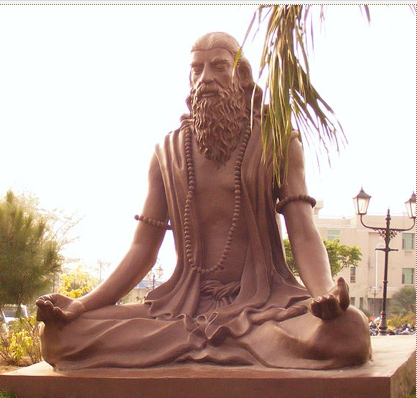
Statue of Patanjali, Haridwar, India
In the Vedanta, there are usually four classifications of consciousness: dreamless sleep, dream sleep, ordinary consciousness, and a fourth transcendental state (divided, perhaps, into varying subtle sub-states). In his yoga sutras, the ancient sage and grammarian, Patanjali, explores the three ordinary states of consciousness and how to attain, though progressively disciplining the thought waves of the mind, the fourth, transcendental state of consciousness.

In his book, "Relativity, Philosophy and Mind," the philosopher and polymath spiritual seeker, Paul Brunton, commented on these differing states of consciousness, noting:
Paul Brunton (1898-1982)
"A man never leaves Consciousness. The world comes into it as perception, that is as idea. Whether anything, object or state, comes into it or not, consciousness remains as his unchanging home. Whether asleep or awake, wrapped in himself or out in the world, his essential being remains what it is. His thoughts and sense-impressions, feelings and passions are produced by it or projected from it: they exist in dependence on it and die in it."

"(E)ven deep sleep unconsciousness is a form of this "consciousness" which transcends all the states we ordinarily know - waking, dream and deep sleep - yet includes them when they merge back into it. Such a "consciousness" is unthinkable, unimaginable, but it is the true objective awareness. It is also the I you are seeking so much. But to reach it, then you have to let go of the I which you know so well."
["The Notebooks of Paul Brunton," vol. 13, para 183-184]
In the video embedded below, Paramahansa Nithyananada comments on the classical yoga teachings of Patanjali, 2,000 year old teachings that deal extensively with the four states of consciousness in setting out the yoga techniques which are required to reach the fourth transcendental state. The problem for the vast majority of people, however, Nithyananda notes, is that even in our waking state we are prone to be absent-minded or "dreaming."

Paramahansa Nithyananda
"The whole of humanity is sleep walking, except the man who is awakened, the man who is enlightened," says Paramahansa Nethyananda in his explanation of Patanjali's yoga sutras. "Being absent-minded, not being alive in the state in which you are is what I call 'sleep.' . . . Otherwise (for) all problems you face, you have a solution."

"There is no problem which cannot be solved," he notes. "All problems can be completely solved with only one thing: You need to be available. . . . All problems are created when you are not available. When you are not available you mess up the whole thing."

"Because of absent-mindedness people miss many things," says Nithyananda, "their relationships, their life, their positions. Many things get missed. (Being) absent-mindedness during talking with others, or during your your activities, you will lose your worries. (Being) absent-mindedness during your inner planning, inner visualization, inner thinking, (we) understand is the worst one. You will miss some (important) links."

If you are "absent -mindedness in your outer world," he observes, "you lose only things of the outer world. . . . But forgetting to keep your (inner) thoughts, you lose the things that you really need in your life. You lose too many big things."


Thursday, April 28, 2011

Krishnamurti on Wealth and Enlightenment

All of the world's great religious or wisdom traditions address the impossibility of reaching higher states of consciousness and spiritual realization while attachments to the people and things that seem so important to our egoic self-consciousness remain.

Perhaps the most famous of these teachings are Jesus' encounter with "the rich young man" ( Matt. 19:16-22), and his saying that it is easier for camel to go through the eye of a needle than for a rich man to enter into the kingdom of God (Matt 19:23-24; Luke 18:24) - the kingdom of God which he specifically and plainly said was within us all (Luke 17:21).

Buddhist and Vedanta yoga traditions each stress the importance of non-attachment, while Judaism, Christianity and Islam each teach the importance of charity, a specific form of non-attachment. But it is perhaps the modern spiritual teacher, Jiddu Krishnamurti, who best explains why attachment to the things and people of the world are a hindrance to those who are on the path to spiritual enlightenment.


"For the rich as for the poor it is extremely difficult to find reality," Krishnamurti observed, further noting:
"The poor crave to be rich and powerful, and the rich are already caught in the net of their own action; and yet they believe and venture near. They speculate, not only upon the market, but upon the ultimate. They play with both, but are successful only with what is in their hearts. The beliefs and ceremonies, their hopes and fears have nothing to do with reality, for their hearts are empty. The greater the outward show, the greater the inward poverty."

"To renounce the world of wealth, comfort and position is a comparatively simple matter; but to put aside the craving to be, to become, demands great intelligence and understanding. The power that wealth gives is a hindrance to the understanding of reality, as is also the power of gift and capacity. This particular form of confidence is obviously an activity of the self; and though it is difficult to do so, this kind of assurance and power can be put aside. But what is much more subtle and more hidden is the power and the drive that lie in the craving to become."

"Self-expansion in any form, whether through wealth or through virtue, is a process of conflict, causing antagonism and confusion. A mind burdened with becoming can never be tranquil, for tranquility is not a result either of practice or of time. Tranquility is a state of understanding, and becoming denies this understanding. Becoming creates the sense of time, which is really the postpone of understanding. The "I shall be" is an illusion of self-importance."
Perhaps this is why it is "the poor in spirit" who are "blessed" for "theirs is the kingdom of heaven," according to Jesus in the 'Be-attitudes' which served as the introduction to his famous "Sermon on the Mount." For it is "the poor in spirit" who are non-attached to the things or people of the world, and are not interested in "becoming" anything; rather they are the ones who are simply 'beings,' and spiritual beings at that. Spiritual beings who truly dwell within their "be-ing"

Friday, April 15, 2011

To Abide in One's True Nature: Satchitananda

"Do not be conformed to the
world; rather, be transformed
by the renewal of your mind."

(Romans 12:2)
"What is the true nature of man?," asks Swami Prabhavananda, co-author (with Christopher Isherwood) of "How to Know God: The Yoga Aphorisms of Patanjali."

"Satchitananda brahman," he says, in the attached video. "Pure consciousness, life eternal, and abiding love, and infinite joy. That is your true nature, which is one with Brahma. And when . . . the mind is kept under complete control, your true nature is revealed to you."

There are two types of knowledge, Prabhavananda notes, "scientific or analytical knowledge" and "transcendental vision" or "yogic knowledge, realization and experience." This second type of knowledge, he notes, can only be attained when a man realizes and abides in his true nature as satchitananda brahman. "Then it is," says Prabhavanda, "that he has attained the purpose, the fulfillment of human birth (and) human life."

In "How to Know God," Prabhavanda and Isherwood explain that, "(k)nowledge or perception is a thought wave (vritti) in the mind," and that "(a)ll knowledge is therefore objective."
"When an event or object in the external world is recorded by the senses," they explain, "a thought-wave is raised in the mind. The ego-sense identifies itself with this wave. If the thought-wave is pleasant, the ego-sense feels, "I am happy;" if the wave is unpleasant, "I am unhappy."
"This false identification," they note, "is the cause of all our misery - for even the ego's temporary sensation of happiness brings anxiety, a desire to cling to the object of pleasure and this prepares future possibilities of becoming unhappy."

"The real Self, the Atman," they observe, "remains forever outside the power of thought waves, it is eternally pure, enlightened and free - the only true, unchanging happiness."

"It follows, therefore," they say, "that man can never know his real Self as long as the thought-waves and the ego-sense are being identified. "In order (for us) to become enlightened," they conclude, "we must bring the thought-waves under control so that this false identification may cease."
"Do not be conformed to the world; rather, be transformed by your mind," says Saint Paul: (Romans 12:2). "We have to  . . . unlearn the false identification of the thought-waves with the ego-sense," say Prabhavananda and Isherwood. "This process of unlearning involves a complete transformation of character, a "renewal of the mind," as St. Paul puts it."
["How to Know God," pages 18-19.]