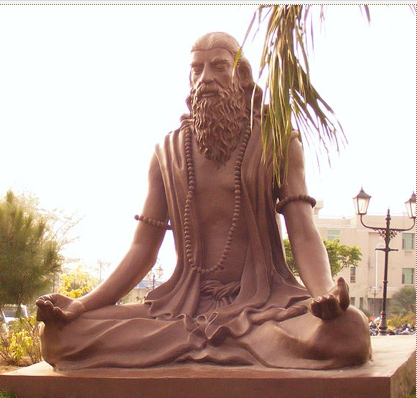
In the
Vedanta, there are usually four classifications of consciousness: dreamless sleep, dream sleep, ordinary consciousness, and a fourth transcendental state (divided, perhaps, into varying subtle sub-states). In his yoga sutras, the ancient sage and grammarian,
Patanjali, explores the three ordinary states of consciousness and how to attain, though progressively disciplining the thought waves of the mind, the fourth, transcendental state of consciousness.
In his book, "
Relativity, Philosophy and Mind," the philosopher and polymath spiritual seeker,
Paul Brunton, commented on these differing states of consciousness, noting:
"A man never leaves Consciousness. The world comes into it as perception, that is as idea. Whether anything, object or state, comes into it or not, consciousness remains as his unchanging home. Whether asleep or awake, wrapped in himself or out in the world, his essential being remains what it is. His thoughts and sense-impressions, feelings and passions are produced by it or projected from it: they exist in dependence on it and die in it."
"(E)ven deep sleep unconsciousness is a form of this "consciousness" which transcends all the states we ordinarily know - waking, dream and deep sleep - yet includes them when they merge back into it. Such a "consciousness" is unthinkable, unimaginable, but it is the true objective awareness. It is also the I you are seeking so much. But to reach it, then you have to let go of the I which you know so well."
In the video embedded below, Paramahansa Nithyananada comments on the classical yoga teachings of Patanjali, 2,000 year old teachings that deal extensively with the four states of consciousness in setting out the yoga techniques which are required to reach the fourth transcendental state. The problem for the vast majority of people, however, Nithyananda notes, is that even in our waking state we are prone to be absent-minded or "dreaming."
"The whole of humanity is sleep walking, except the man who is awakened, the man who is enlightened," says Paramahansa Nethyananda in his explanation of Patanjali's yoga sutras. "Being absent-minded, not being alive in the state in which you are is what I call 'sleep.' . . . Otherwise (for) all problems you face, you have a solution."
"There is no problem which cannot be solved," he notes. "All problems can be completely solved with only one thing: You need to be available. . . . All problems are created when you are not available. When you are not available you mess up the whole thing."
"Because of absent-mindedness people miss many things," says Nithyananda, "their relationships, their life, their positions. Many things get missed. (Being) absent-mindedness during talking with others, or during your your activities, you will lose your worries. (Being) absent-mindedness during your inner planning, inner visualization, inner thinking, (we) understand is the worst one. You will miss some (important) links."
If you are "absent -mindedness in your outer world," he observes,
"you lose only things of the outer world. . . . But forgetting to keep your (inner) thoughts, you lose the things that you really need in your life. You lose too many big things."