Friday, April 29, 2011

Absent-Mindedness and the Four States of Consciousness

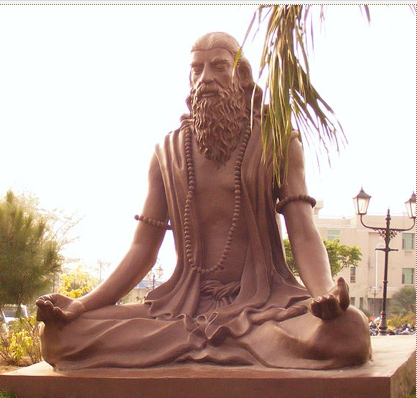
Statue of Patanjali, Haridwar, India
In the Vedanta, there are usually four classifications of consciousness: dreamless sleep, dream sleep, ordinary consciousness, and a fourth transcendental state (divided, perhaps, into varying subtle sub-states). In his yoga sutras, the ancient sage and grammarian, Patanjali, explores the three ordinary states of consciousness and how to attain, though progressively disciplining the thought waves of the mind, the fourth, transcendental state of consciousness.

In his book, "Relativity, Philosophy and Mind," the philosopher and polymath spiritual seeker, Paul Brunton, commented on these differing states of consciousness, noting:
Paul Brunton (1898-1982)
"A man never leaves Consciousness. The world comes into it as perception, that is as idea. Whether anything, object or state, comes into it or not, consciousness remains as his unchanging home. Whether asleep or awake, wrapped in himself or out in the world, his essential being remains what it is. His thoughts and sense-impressions, feelings and passions are produced by it or projected from it: they exist in dependence on it and die in it."

"(E)ven deep sleep unconsciousness is a form of this "consciousness" which transcends all the states we ordinarily know - waking, dream and deep sleep - yet includes them when they merge back into it. Such a "consciousness" is unthinkable, unimaginable, but it is the true objective awareness. It is also the I you are seeking so much. But to reach it, then you have to let go of the I which you know so well."
["The Notebooks of Paul Brunton," vol. 13, para 183-184]
In the video embedded below, Paramahansa Nithyananada comments on the classical yoga teachings of Patanjali, 2,000 year old teachings that deal extensively with the four states of consciousness in setting out the yoga techniques which are required to reach the fourth transcendental state. The problem for the vast majority of people, however, Nithyananda notes, is that even in our waking state we are prone to be absent-minded or "dreaming."

Paramahansa Nithyananda
"The whole of humanity is sleep walking, except the man who is awakened, the man who is enlightened," says Paramahansa Nethyananda in his explanation of Patanjali's yoga sutras. "Being absent-minded, not being alive in the state in which you are is what I call 'sleep.' . . . Otherwise (for) all problems you face, you have a solution."

"There is no problem which cannot be solved," he notes. "All problems can be completely solved with only one thing: You need to be available. . . . All problems are created when you are not available. When you are not available you mess up the whole thing."

"Because of absent-mindedness people miss many things," says Nithyananda, "their relationships, their life, their positions. Many things get missed. (Being) absent-mindedness during talking with others, or during your your activities, you will lose your worries. (Being) absent-mindedness during your inner planning, inner visualization, inner thinking, (we) understand is the worst one. You will miss some (important) links."

If you are "absent -mindedness in your outer world," he observes, "you lose only things of the outer world. . . . But forgetting to keep your (inner) thoughts, you lose the things that you really need in your life. You lose too many big things."


Thursday, April 28, 2011

Krishnamurti on Wealth and Enlightenment

All of the world's great religious or wisdom traditions address the impossibility of reaching higher states of consciousness and spiritual realization while attachments to the people and things that seem so important to our egoic self-consciousness remain.

Perhaps the most famous of these teachings are Jesus' encounter with "the rich young man" ( Matt. 19:16-22), and his saying that it is easier for camel to go through the eye of a needle than for a rich man to enter into the kingdom of God (Matt 19:23-24; Luke 18:24) - the kingdom of God which he specifically and plainly said was within us all (Luke 17:21).

Buddhist and Vedanta yoga traditions each stress the importance of non-attachment, while Judaism, Christianity and Islam each teach the importance of charity, a specific form of non-attachment. But it is perhaps the modern spiritual teacher, Jiddu Krishnamurti, who best explains why attachment to the things and people of the world are a hindrance to those who are on the path to spiritual enlightenment.


"For the rich as for the poor it is extremely difficult to find reality," Krishnamurti observed, further noting:
"The poor crave to be rich and powerful, and the rich are already caught in the net of their own action; and yet they believe and venture near. They speculate, not only upon the market, but upon the ultimate. They play with both, but are successful only with what is in their hearts. The beliefs and ceremonies, their hopes and fears have nothing to do with reality, for their hearts are empty. The greater the outward show, the greater the inward poverty."

"To renounce the world of wealth, comfort and position is a comparatively simple matter; but to put aside the craving to be, to become, demands great intelligence and understanding. The power that wealth gives is a hindrance to the understanding of reality, as is also the power of gift and capacity. This particular form of confidence is obviously an activity of the self; and though it is difficult to do so, this kind of assurance and power can be put aside. But what is much more subtle and more hidden is the power and the drive that lie in the craving to become."

"Self-expansion in any form, whether through wealth or through virtue, is a process of conflict, causing antagonism and confusion. A mind burdened with becoming can never be tranquil, for tranquility is not a result either of practice or of time. Tranquility is a state of understanding, and becoming denies this understanding. Becoming creates the sense of time, which is really the postpone of understanding. The "I shall be" is an illusion of self-importance."
Perhaps this is why it is "the poor in spirit" who are "blessed" for "theirs is the kingdom of heaven," according to Jesus in the 'Be-attitudes' which served as the introduction to his famous "Sermon on the Mount." For it is "the poor in spirit" who are non-attached to the things or people of the world, and are not interested in "becoming" anything; rather they are the ones who are simply 'beings,' and spiritual beings at that. Spiritual beings who truly dwell within their "be-ing"

Wednesday, April 27, 2011

Emerson's Harvard Divinity School Address: Reflections on the Sublime

The dean of the American Transcendentalists, Ralph Waldo Emerson, was in many ways the forefather of the spiritual awakening that many people feel arising in our times. Heavily influenced by the first widespread introduction of Eastern wisdom teachings to the West, Emerson was a champion of the universality of religious teachings and a non-dualist, as the following excerpts from his renowned address to the Harvard Divinity School show.

The site of Ralph Waldo Emerson's
Harvard Divintiy School address.
His address, delivered in the inner sanctum of the Unitarian Church's highest seat of learning, the Harvard Divinity School address was in many ways an heroic stand that Emerson made for his then radical beliefs. Shortly thereafter, he resigned as a Unitarian minister, and although lecturing to receptive audiences worldwide, he was not invited to speak again at Harvard for another thirty years.

Some 175 years later, Emerson's observations on the nature of God and man remain as clear and relevant to our times as they were then. Indeed, they are perhaps more so today, given the current conflicts we see between and among fundamentalists of all faiths, and the spiritual awakening one nonetheless senses amongst both persons of all faiths, and of no one faith in particular. ("As we are, so we associate," Emerson observed. "The good, by affinity, seek the good; the vile, by affinity, the vile. Thus of their own volition, souls proceed into heaven, into hell.")

Ralph Waldo Emerson
(1803-1882)
In addressing his audience at the Divinity School, Emerson observed:
"The intuition of the moral sentiment is an insight of the perfection of the laws of the soul. These laws execute themselves. They are out of time, out of space, and not subject to circumstance. . . . If a man is at heart just, then in so far is he God; the safety of God, the immortality of God, the majesty of God do enter into that man with justice. If a man dissemble, deceive, he deceives himself, and goes out of acquaintance with his own being. . . . The man who renounces himself, comes to himself by so doing."

"These facts have always suggested to man the sublime creed, that the world is not the product of manifold power, but of one will, of one mind; and that one mind is everywhere, in each ray of the star, in each wavelet of the pool, active; and whatever opposes that will, is everywhere baulked and baffled, because things are made so, and not otherwise. "
In pointed and specific, yet beautiful and poetically transcendent language, Emerson observes that mankind's religious or spiritual sentiments are universal, arising in the East, yet giving truth to the 'Being' in each individual. Thus, he notes:
" . . . The perception of this law of laws always awakens in the mind a sentiment which we call the religious sentiment, and which makes our highest happiness. Wonderful is its power to charm and to command. It is a mountain air. It is the embalmer of the world. . . . It makes the sky and the hills sublime, and the silent song of the stars is it. By it, is the universe made safe and habitable, not by science or power. Thought may work cold and intransitive in things, and find no end or unity. But the dawn of the sentiment of virtue on the heart, gives and is the assurance that Law is sovereign over all natures, and the worlds, time, space, eternity, do seem to break out into joy."

" . . . This thought dwelled always deepest in the minds of men in the devout and contemplative East; not alone in Palestine, where it reached its purest expression, but in Egypt, in Persia, in India, in China. Europe has always owed to oriental genius, its divine impulses. What these holy bards said, all sane men found agreeable and true.

" . . . The divine bards are the friends of my virtue, of my intellect, of my strength. They admonish me, that the gleams which flash across my mind, are not mine, but God's; that they had the like and were not disobedient to the heavenly vision. So I love them. Noble provocations go out from them, inviting me also to emancipate myself; to resist evil to subdue the world; and to Be."


Monday, April 25, 2011

'One-ness,' Non-Duality and Perception

"There's many mystical states of consciousness," says neo-Buddhist spiritual teacher, Adyashanti, "but in terms of spiritual awakening they are relatively irrelevant."

"One-ness," says Adyashanti, a master of non-dualism, "is actually an unaltered state of consciousness. People think its some whacked out state of mystical consciousness." But it's not, he insists. "Everything else is a whacked out state of mystical consciousness. One-ness is just the way things are. Its just the restoration of clear, simple perception."


"Awakening to the truth is a deep realization of what you are as an  experience," Adyashanti writes in his essay, 'Realizing Your True Nature.'

"What is it that is feeling," he asks? "What is it that is thinking or sensing? This is not about coming up with the right name for it, so don't name it for a moment. It's about just noticing, just experiencing.  Feel it. Sense it. Welcome it. Spiritual awakening is realizing what  occupies the space called 'me.' When you listen innocently, you'll see that there really is something more here than a 'me.'"

"Your 'me' might call itself Hindu, Christian, Buddhist, Advaitan, atheist, agnostic, believer, or nonbeliever, but no matter what your me is identified with, when you become very open and relaxed, you can suddenly be aware that  something else is occupying your body-mind. Something else is looking out from your eyes, listening from your ears, and feeling your feelings." 

"That something," Adyashanti notes, "has no qualities. Realizing your true nature is  realizing what is present without qualities. We can call it the emptiness of consciousness, the Self, or the No-Self. To directly  experience this emptiness, 'the aliveness of it,' is spiritual awakening. It is to realize yourself as beautiful nothingness, or more accurately, no-thing-ness. If we say it's 'nothing,' we miss the point."

Sunday, April 24, 2011

Paul Brunton On a Transcendent God-Consciousness

Often we are asked, "How could a loving God allow such and such." Whether it is drought, floods, earthquakes, tsunamis, disease or hurricanes, there remains a tacit assumption (at least in the West) that there is an anthropomorphic God pulling the strings of the universe and/or predesignating the tide of human affairs, despite the much-vaunted teleological argument of "free will."

A more sophisticated - and, perhaps, more Eastern - viewpoint, is that a supreme consciousness interpenetrates our world from beyond space-time, and that it is in attuning to this higher, transcendental God-consciousness that the mystics, contemplatives, sges and mystics of all times and traditions have taken refuge from the egoic "self."

Paul Brunton (1898-1981)
In "Relativity, Philosophy and Mind," the philosopher and spiritual pundit, Paul Brunton, addresses these points, writing:

"If the worldly man agitatedly sees the event against the background of a moment, if the philosophic student calmly sees it against the background of a lifetime, the sage, while fully aware of both these points of view, offsets them altogether by adding a third one which does not depend on any dimension of time at all. From this third point of view, he sees both the event itself and the ego to whom it happens as illusory. Deep within his mind he holds unshakeably to the timeless character of true being, to the eternal life of the kingdom of heaven."

"In this mysterious state time cannot heal, for there are no wounds present to be healed. So soon as we can take the reality out of time, so soon we take the sting out of suffering. For the false self lives like a slave, bound to every passing sensation, whereas the true self lives in the timeless peace of the kingdom of heaven."

"As soon as we put ourselves into harmony with the true self, we put ourselves into harmony with the whole universe; we put ourselves beyond the reach of calamity. It may still happen, but it does not happen to nor is it felt by our real self. There is a sense of absolute security, a feeling that no harm can come to us. The philosophic student discovers the mission of time; it heals sorrow and, under karma or through evolution, cures evil. The sage solves the mystery of timelessness, which redeems man."
As Jesus told the Pharisees who were hounding him, "The kingdom of heaven cannot be found by observation. Lo it is not here. Lo it is not there. The kingdom of heaven is within you." (Luke 17:20-21.)

Thus, especially when calamity and disaster appear to surround us, we should "seek first the kingdom" within us, rather than asking why some external God could have stage-managed the seeming 'disaster' in our lives.

Friday, April 22, 2011

Andrew Cohen and Rupert Sheldrake: Is Evoution Sacred?

In a thought-provoking dialogue (below) between spiritual teacher Andrew Cohen and the innovative biologist Rupert Sheldrake, two voices from the leading-edge of our post-modern culture discuss whether evolution, itself, may perhaps be sacred.

Noted biologist and author,
Dr. Rupert Sheldrake.
"We can become aware of our connection to the cosmos and this vast evolutionary process," says Sheldrake," but the question is: 'Where is it going?' Does it just go ever and onwards and upwards forever until we get more and more enlightened and more and more cosmically aware? Or, does there come a point where there is some kind of a culmination of the whole cosmic evolutionary process?"

Noting that the Judeo-Christian tradition, which gave us "the vision of a progressive evolution in time," always had an explicit goal in the future, Sheldrake asks Cohen (a proponent of the teaching he calls "evolutionary enlightenment") what an 'end-state' to the evolutionary process would be.

In observing that it is a "big picture" answer that frankly verges on "the realm of fantasy," Cohen notes that the "direction or the 'teleos' of the evolutionary process is towards consciousness itself."

Spiritual teacher, Andrew Cohen,
Editor-in-Chief of EnlightenNext
magazine.
Cohen posits that, "it would seem that the urge towards consciousness would be fulfilled, or would be ultimately completed, when all the matter in the cosmos had become enlightened - which means conscious. When all the matter in the cosmos had become fully enlightened," he observes, "we would say that the primary urge - if that's what it is - would be vanquished, that it would be fulfilled."

Noting that the process has "barely begun," Cohen  observes that we are at the very beginning of a process that is of such infinite proportions that it is nearly impossible to conceive. Nevertheless,  he calls this "urge to become conscious" our primary driving motivation.

For his part, Sheldrake - an innovative biologist who is noted for his theory of 'morphic fields' - observes that "there is already a large degree of consciousness throughout the  universe, and perhaps that extra awareness comes from us, rather than somehow by our own conscious development we are going to inject consciousness into the rest of the universe."

Their discussion is a fascinating leading-edge discussion of concepts that have long been an integral aspect of the ultimate teachings of both Mahayana Buddhism and the Advaita Vedanta, as two of the most innovative contemporary minds approach what may be thought of as "the biggest question" from two very different directions . . . and nonetheless come to agreement.

"When consciousness awakens to itself, Cohen concludes, "that's when everything comes alive." A point which is acceded whole-heartedly by Sheldrake.

Wednesday, April 20, 2011

"Religion" vs. the "New Atheism"

Author, Sam Harris
("Letter to a Christian Nation")
Addressing the Enilghtenment 2.0 conference held in 2007, best selling author and religious critic, Sam Harris (author of "Letter to a Christian Nation"), observed:
"There is nothing about science that entails a criticism of religion, and there is nothing about science that entails a commitment to atheism. This, I think is to be misled by words. Words like religion and atheism. Science clearly does not entail that one identify one's self as an atheist, or even think of one's self as an atheist. But science does entail that one be skeptical of unsupported and unsupportable claims about miracles and about the divine origin of certain books. And when you dig into the details, this is all atheism is. Atheism is the failure to be convinced by other people's claims about miracles, and it is the conviction that they too should not be convinced."

"If there is something worth discussing in the experience of a Buddha or a Jesus . . . as I think there is, I think there is really a 'there' there . . . I think it is possible to have a rare and beautiful and transformative experience . .  and we can call that spirituality or mysticism . . . If there is something worthy of discussion there," says Harris, "it should be susceptible to rational inquiry, and we can hold mystics and contemplatives to the highest standards of empirical rigour and logical coherence. It's simply a myth to say that we can't."

But defining science as the best of our knowledge about the physical universe, Harris does not define what "religion" is to him, before veering off into a discussion of what roles religion and empirical science may have to play in morality and ethics . . . and then going completely off the rails.

Narrowly conflating religion with (i) miracles, (ii) divine origination of scripture, and (iii) ethics, Harris provocatively states that, "The truth is understanding a scriptural tradition is no more relevant to questions of ethics than it is to questions of astrology." And here he misses the point, as do so many leading voices of what Harris himself derides as "the New Atheism."

What Harris misses by leaving his definition of religion unexamined is that there is within religion a vast difference between inner religious experience and the outward dogmas and creeds that encompass Harris' unspoken narrow definition of what religion is.

Yet while, Harris acknowledges that there may be something worthy of discussion in the experiences of "a Buddha and a Jesus," he fails to do so. Buddhism, in particular, is strictly speaking already an 'atheistic religion,' in which its "founder," Gautama Buddha specifically urged his followers not to take his teachings on faith, but rather urged that they should try doing what he did and finding out the truths he talked of experientially, a far more scientific viewpoint (repeatability of 'experiments' and results being, along with the ability to falsify theoretical predictions, being the hallmarks of the scientific method), than perhaps Harris is aware of.

William James (1842-1910)
William James, an acknowledged founder of the modern study of psychology and the father of the 'pragmatic school' of American psychology, delivered perhaps his most famous addresses in the Gifford lectures, a series of talks he later published as "The Varieties of Religious Experience." In so doing, he clearly distinguished between inner religious experience of higher states of 'spiritual' consciousness and the outer religious forms of rites, rituals, creeds and dogmas. Yet this distinguishment is assiduously avoided by Harris, as it is by Christopher Hitchins, the biologist, Richard Dawkins, and other advocates of Harris' brand of "atheism."

There is a strong argument to be made that pro-science religious critics, like Harris, avoid talking about inner religious experience because it has everything to do with "consciousness," a subject area that science, particularly the mind sciences, are uncomfortable with and, thus, somewhat reluctant to approach.

However, with the increasing recognition of the work of leading scientists like the biologist Rupert Sheldrake, the neuroanatomists V.S. Ramachadran, David Chalmers and Dan Siegel, as well as that of synthesist physical/metaphysical theorists like Alan Wallace or the late David Bohm on consciousness, it can be hoped that the seemingly forever ongoing debate between science and religion may at some near point be conducted within mutually agreed upon terms.

After all, even the once most staid of religious institutions, the Catholic Church, has - if I can paraphrase a master metaphysicist - learned to "render unto Galileo what is Galileo's, and render unto God what is God's." It is high time, then, for religious critics to fully and honestly debate the questions of inner religious experience, instead of narrowly and dishonestly restricting their debate to matters solely of external religious beliefs, dogmas and ethics.