Showing posts with label spirituality. Show all posts

Sunday, October 2, 2011

Do Not Judge "Others"

"Abbot Joseph asked Abbot Pastor: Tell me how I can become a monk? The elder replied: If you want to have rest here in this life and also in the next, in every conflict with another say: Who am I? And judge no one."
 -- Thomas Merton --
("The Wisdom of the Desert")

"Judge not, lest ye be judged," we are advised (Matthew 7:1). In the spiritual life, to judge is to separate ourselves from everyone and everything, to invite the perception of duality and separation into our lives. Once we sit in judgment on another, we become our own judge. And not just our own judge, but also our own jury, jailer and hangman. Thus the wisdom of the desert father to "judge no one," lest we judge ourselves into a spiritual corner from which we cannot escape.

If we ask just who we are, irrespective of the situation we find ourselves in, we are forced to confront the question of whether we are again identified with the narrow self of the individual ego, or whether we are identified with the broader depth of our authentic Being. If we are inspired, we shall see that there really is no clear differentiation between our self and others, that we are all part of "the Kingdom of God" which is within us, and that there is no "other" to judge. Thus ask, "Who am I? And do not judge others."


Wednesday, September 28, 2011

Erich Fromm: On America's Consumer Society

The more things change, the more they stay the same. The truism of this adage is abundantly clear when one views this 1958 interview that Mike Wallace conducted with the great psychoanalyst and social critic, Erich Fromm. Particularly in his criticism of materialism as an ends rather than a means to happiness and meaning, Fromm's observations on American society - an America before civil rights, before the 1960s, before the Internet, an America under the threat of nuclear war - presage contemporary criticisms of our consumer society.

"Because in our enthusiasm to dominate nature and produce more material goods, we have transformed means into ends," Fromm notes. "We wanted to produce more in the 19th century and the 20th century in order to give man the possibility of a more dignified life. But actually what has happened is that production and consumption have ceased to be means and have become ends. And we are production crazy and consumption crazy."

"(Man's) work is to a large extent meaningless because he is not related to it," Fromm points out. "He is increasingly part of a big social machinery governed by a big bureaucracy, and I think (that) unconsciously he hates his work very often because he feels trapped (and) imprisoned by it. He feels that he is spending most of his energy for something that has no meaning in itself."

"Men, today, being concerned with production and consumption as ends in themselves have very little energy (or) time to devote themselves to true religious experience."


Saturday, September 24, 2011

Eckhart Tolle: Freedom from the Ego

Eckhart Tolle
". . . (T)hinking without awareness is the main dilemma of human existence."
-- Eckhart Tolle --
Being free of the smaller self, free of ego, is the transformational goal of all the world's great wisdom traditions. In self-forgetting we awaken to the divinity within each of us, indeed, to the divinity that infuses, pervades and supports all we see. We become whole and realize that we are part of the Whole, rather than isolated individuals.

How is such a transformation of the psyche to be achieved, however? Best-selling author, Eckhart Tolle, a spiritual teacher of no small repute, emphasizes that the key to overcoming the limitations of the ego lies in our present moment awareness.

"All that is required to become free of the ego," he notes, "is to be aware of it, since awareness and ego are incompatible. Awareness is the power that is concealed within the present moment. This is why we may also call it Presence. The ultimate purpose of human existence, which is to say, your purpose, is to bring that power into this world. And this is also why becoming free of the ego cannot be made into a goal to be attained at some point in the future. Only Presence can free you of the ego, and you can only be present Now, not yesterday or tomorrow. Only Presence can undo the past in you and thus transform your state of consciousness."

With Oprah, co-hosts of "A New Earth"
web seminar. (Available here.)
"Spiritual realization," he continues, "is to see clearly what I perceive, experience, think, or feel is ultimately not who I am, that I cannot find myself in all those things that continuously pass away. The Buddha," he points out, "was probably the first human being to see this clearly, and so anata (no self) became one of the central points of his teaching. And when Jesus said, "Deny thyself," what he meant was: Negate (and thus undo) the illusion of self. If the self - ego - were truly who I am, it would be absurd to deny it."

[Tolle, "A New Earth: Awakening to Your Life's Purpose," pp. 78-79.]


Friday, September 16, 2011

Thomas Merton: On Action and Acceptance

In his study of Eastern religious and wisdom traditions, a study cut short by his untimely death, the Trappist monk, Thomas Merton, delved deeply into the heart of those traditions, finding the common ground that each shares with his own Christian faith  Not surprisingly, in his reflections on Hinduism (taken from his pithy book, "Thoughts On the East") he identifies the relentless pursuit of one's own self-will as the primary obstacle to spiritual growth and lasting happiness.

"The hazard of the spiritual quest is of course that its genuineness cannot be left to our own isolated subjective judgment alone," Merton points out. "We do not simply create our own lives on our own terms. Any attempt to do so is ultimately an affirmation of our individual self as ultimate and supreme. This is a self-idolatry which is diametrically opposed to Krishna consciousness or to any other authentic form of religious or metaphysical consciousness."

"The Gita," he notes, "sees that the basic problem of man is his endemic refusal to live by a will other than his own. For in striving to live entirely by his own individual will, instead of becoming free, man is enslaved by forces even more exterior and more delusory than his own transient fancies. He projects himself out of the present into the future. He tries to make for himself a future that accords with his own fantasy, and thereby escape from a present reality which he does not fully accept. And yet, when he moves into the future he wanted to create for himself, it becomes a present that is once again repugnant to him. And yet this is what he had "made" for himself - it is his karma."

"In accepting the present in all its reality as something to be dealt with precisely as it is," Merton writes, "man comes to grips at once with his karma and with a providential will which, ultimately, is more his own than what he currently experiences on a superficial level, as "his own will.""

"It is in surrendering a false and illusory liberty on the superficial level that man unites himself with the inner ground of reality and freedom in itself which is the will of God, of Krishna, of Providence, of Tao."

* * * * * * * * * * * * * *

An anonymous writer made the following observations about the challenges and hazards we create in refusing to accept life on life terms, and about the spiritual benefits that come to us when we do:
"(A)cceptance is the answer to all my problems today. When I am disturbed, it is because I find some person, place, thing, or situation - some fact of my life - unacceptable to me, and I can find no serenity until I accept that person, place, thing, or situation as being exactly the way it is supposed to be at this moment. Nothing absolutely nothing happens in God's world by mistake. . . . (U)nless I accept life completely on life's terms, I cannot be happy. I need to concentrate not so much on what needs to be changed in the world as on what needs to be changed in me and my attitudes."

"Shakespeare said, "All the world's a stage, and all the men and women mere players." He forgot to mention that I was the chief critic. I was always able to see the flaw in every person, every situation. And I was always glad to point it out, be ause I knew you wanted perfection, just as I did. . . . (A)cceptance (has) taught me that there is a bit of good in the worst of us and a bit of bad in the best of us; that we are all children of God and we each have a right to be here. When I complain about me or about your, I am complaining about God's handiwork. I am saying that I know better than God."

Sunday, August 21, 2011

Within the Kingdom of God & the Kingdom of God Within

"In the Kingdom of Heaven all is in all, all is one, and all is ours."
-- Meister Eckhart --
"The world inhabited by ordinary, nice, unregenerate people," observes Aldous Huxley, "is mainly dull (so dull that they have to distract their minds from being aware of it by all sorts of artificial "amusements"), some times briefly and intensely pleasurable, occasionally or quite often disagreeable and even agonizing." However, Huxley notes, "(F)or those who have deserved the world by making themselves fit to see God within it as well as within their own souls, it wears a very different aspect."
[Aldous Huxley, "The Perennial Philosophy," p. 75.]

In one of the most significant passages in the New Testament, Jesus, who had been perpetually persecuted for his views by the Pharisees, and thus spoke of the Kingdom of Heaven exclusively in parables, speaks unambiguously to his persecutors. When asked by the Pharisees where the Kingdom of Heaven might be found, he replies directly, "The kingdom of God cometh not with observation: Neither shall they say, Lo here! or, lo there! for, behold, the kingdom of God is within you." (Luke 17: 20-21.) Then, in the apocryphal Gospel of Thomas, when asked by his disciples when the Kingdom of God would come, he replies: "It will not come by watching for it. It will not be said, 'Look, here!' or 'Look, there!' Rather, the Father's kingdom is spread out upon the earth, and people don't see it." (Gospel of Thomas, Verse 113.)

Thus, it may be seen, as Huxley observed (above), that our being and our environment take on very different aspects depending upon whether we have a mundane or supermundane understanding of their nature. Alluding to these two very different ways of seeing the world, Jesus (again, from the Gospel of Thomas, at Verse 77) tells his disciples: "I am the light that is over all things. I am all: from me all came forth, and to me all attained. Split a piece of wood; I am there. Lift up the stone, and you will find me there."

"It is in the Indian and Far Eastern formulations of the Perennial Philosophy," notes Huxley, "that this subject is most systematically treated.What is prescribed is a process of conscious discrimination between the personal self and the Self that is identical with Brahman, between the individual ego and the Buddha-womb or Universal Mind."

"The result of this discrimination," Huxley points out, "is a more or less sudden and complete "revulsion" of consciousness, and the realization of a state of "no-mind," which may be described as the freeedom from perceptual and individual attachment to the ego-principle. This state of "no-mind" exists, as it were, on a knife-edge between the carelessness of the average sensual man and the strained overeagerness of the zealot for salvation. To achieve it one must walk delicately and, to maintain it, must learn to combine the most intense alertness with a tranquil and self-denying passivity, the most indomitable determination with a perfect submission to the leadings of the spirit."
"When no-mind is sought after by a mind," says Huang Po, "that is making it a particular object of thought. There is only testimony of silence; it goes beyond thinking."
 "In other words," says Huxley, "we, as separate individuals, must not try to think it, but rather permit ourselves to be thought by it."
[Aldous Huxley, "The Perennial Philosophy," pp. 72-73.]

Friday, August 5, 2011

The Philokalia: A Discourse on Abba Philimon

"It is said that Abba Philimon, the anchorite, lived for a long time enclosed in a certain cave not far from the Lavra of the Romans. There he engaged in the life of ascetic struggle, always asking himself the question which, it is reported, the great Arsenios used to put to himself: 'Philemon, why did you come here?'"

"He used to plait ropes and make baskets, giving them to the steward of the Lavra in exchange for a small ration of bread. He ate only bread and salt, and even that not every day. In this way he took no thought for the flesh (cf. Rom. 13:14) but, initiated into ineffable mysteries through the pursuit of contemplation, he was enveloped by divine light and established in a state of joyfulness."

"When he went to church on Saturdays and Sundays he walked alone in deep thought allowing no one to approach him lest his concentration should be interrupted. In church he stood in a corner, keeping his face turned to the ground and shedding streams of tears. For, like the holy fathers, and especially like his great model Arsenios, he was always full of contrition and kept the thought of death continually in his mind."

"When a heresy arose in Alexandria and the surrounding area, Philimon left his cave and went to the Lavra near that of Nikanor. There he was welcomed by the blessed Paulinos, who gave him his own retreat and allowed absolutely no one to approach him, and he himself disturbed him only when he had to give him bread."

"On the feast of the holy resurrection of Christ, Philimon and Paulinos were talking when the subject of the eremetical state came up. Philimon knew that Paulinos, too, aspired to this state; and with this in mind he implanted in him teachings taken from Scripture and the fathers that emphasized, as Moses had done, how impossible it is to conform to God without complete stillness; how stillness gives birth to ascetic effort, ascetic effort to tears, tears to awe, awe to humility, humility to foresight, foresight to love; and how love restores the soul to health and makes it dispassionate, so that one then knows that one is not far from God."

-- A Discourse on Abba Philimon --
(Palmer et al., "The Philokalia," Vol. Two, pp. 244-345.)

Wednesday, August 3, 2011

Mother Theresa: On Suffering

"There is much suffering in the world - very much. Material suffering is suffering from hunger, suffering from homelessness, from all kinds of disease, but I still think that the greatest suffering is being lonely, feeling unloved, just having no one. I have come to more and more realize that it is being unwanted that is the worst disease that any human being can ever experience."

"In these times of development, the whole world runs and is hurried. But there are some who fall down on the way and have no strength to go ahead. These are the ones we must care about."


"Let us be very sincere in our dealings with each other and have the courage to accept each other as we are. Do not be surprised at or become preoccupied with each other's failure; rather see and find the good in each other, for each one of us is created in the image of God. Jesus said it beautifully: "I am the vine, you are the branches." The life giving sap that flows from the vine through each of the branches is the same."

-- Mother Theresa --
("In the Heart of the World")

Lao Tzu: The Taoist Sage

"Outside the universe, sages see without discussion. Inside the universe, sages discuss without deliberation. When it comes to the passing times and generations and the records of kings of yore, sages deliberate without debating."

"Therefore there is that which distinction does not distinguish, there is that which explanation does not explain. What is it? Sages take it to heart, average people try to explain it to each other. That is why it is said that there is something not seen by explanation."

"The Great Way is not called anything: great discernment is unspoken; great humaneness is unsentimental; great honesty is not complacent; great bravery is not vicious."

"When a way is illustrious, it does not guide; when humanitarianism is fixated, it is not constructive; when honesty is puritanical, it is not trusted; when bravery is vicious, it does not succeed. These five things are like looking for squareness in something round."

"So we know that to stop at what we don't know is as far as we can go. Who knows the unspoken explanation, the unexpressed Way? Among those who do know, this is called the celestial storehouse: we can pour into it without filling it we can draw from it without exhausting it; and yet we don't know where it comes from. This is called hidden illumination."

[Thomas Cleary, "The Essential Tao," p. 76.]


Monday, July 18, 2011

The "Journey From God"

"We all come from God, but when we are born into this world we forget. We forget from where we have come and that we are children of light. We take on the clothing of this world, leaving behind,"the clouds of glory' of our true Home. The Sufi calls this the "journey from God," a journey of forgetfulness in which we leave Paradise behind. But there are those who never quite forget, who keep a distant memory buried deep within them. As a result this world never quite seems like home; there is often a sense of not quite belonging, not fitting in. Mystics are strangers in this world, just because they remember their real home."
-- LLewellyn Vaughan-Lee --
("Love Is a Fire: The Sufi's Mystical Journey Home")
 In his Intimations of Immortality from Recollections of Early Childhood, Wordsworth enters the sublime, echoing the teachings of the Sufi, with his intimations of the transmigration of the soul and his explicit recognition of  a universal "home" in the Godhead.

William Wordsworth
“ … Our birth is but a sleep and a forgetting
The soul that rises with us, our life’s Star,
Hath had elsewhere its setting,
And cometh from afar.
Not in entire forgetfulness,
And not in utter nakedness,
But trailing clouds of glory do we come,
From God who is our home.
”
(William Wordsworth, from his poem, "Intimations of Immortality from Recollections of Early Childhood.")
* * * * * * * * * * * * * 


* * * * * * * * * * * * *

ONLY BREATH
Not Christian or Jew or Muslim, not Hindu,
Buddhist, sufi or zen. Not any religion
or cultural system. I am not from the East
or the West, not out of the ocean or up

From the Ground, nor natural or ethereal, not
composed of elements at all. I do not exist,
am not an enemy in this world or the next,
did not descend from Adam or Eve or any

origin story. My place is pathless, a trace
of the traceless. Neither body or soul.

I belong to the beloved, have seen the two
worlds as one and that one call to and know,

first, last, outer, inner, only that
breath, breathing human being.
    << >>                                            
There is a way between voice and presence
where information flows.

In disciplined silence it opens.
With wandering talk it closes.
[Coleman Barks, "The Essential Rumi," p. 34.]

Sunday, June 26, 2011

Science and Religion: Convergence, Synergy and the Clash of Cultures

For me, one of the most interesting synergies of the twenty-first century is the convergence of psychology, science and metaphysics or religion. Of course, this is nothing new, but is the inevitable process of millenial seeking after the 'truths' of what our 'realities' are. What is interesting is the extent to which the different approaches, Eastern and Western, introspective and extrospective, ancient and modern - science on one hand, metaphysics on the other, with psychology somewhere in the middle - are increasingly relevant to each other, and to ever broader swaths of an awakening humanity, irrespective of the often-time violent reactions to such abruptly morphing worldviews.

In 1962, Werner Heisenberg, one of the fathers of quantum theory, observed:
"(I)rrespective of the location and cultural tradition of (the) group, the spirit of modern physics will penetrate into the minds of many people and will connect itself in different ways with the older traditions. What will be the outcome of this impact of a spectial branch of modern science on different powerful old traditions? In those parts of the world in which modern science has been developed the primary interest has been directed for a long time toward practical activity industry and engineering combined with a rational analysis of the outer and inner conditions for such activity. Such people will find it rather easy to cope with the new ideas since they have had time for a slow and gradual adjustment to the modern scientific methods of thinking."

"In other parts of the world these ideas would be confronted with the religious and philosophical foundations of the native culture. Since it is true that the results of modern physics do touch such fundamental concepts as reality space and time, the confrontation may lead to entirely new developments which cannot yet be foreseen. One characteristic feature of this meeting between modern science and the older methods of thinking will be its complete internationality. In this exchange of thoughts the one side, the old tradition, will be different in the different parts of the world, but the other side will be the same everywhere and therefore the results of this exchange will be spread over all areas in which the discussion takes place."
[Heisenberg, "Physics and Philosophy: The Revolution in Modern Science," pp. 1-2.]

Heisenberg's views, written just as the collision of Eastern wisdom traditions with Western science first impacted the wider worldviews of the many varied cultures involved, were prescient indeed. Fifty years later, the results of the impact -both positive and negative - are still shaking out.

Amongst the leading thinkers involved in the synthesis of ancient wisdom traditions with modern science is the Dalai Lama, the spiritual leader of Tibetan Buddhism. In his intriguing book, "The Universe in a Single Atom: The Convergence of Science and Spirituality," he writes:
"When I speak with open-minded scientists and philosophers of science, it is clear that they have a deeply nuanced understanding and a recognition of the limits of scientific knowledge. At the same time, there are many people, both scientists and nonscientists, who appear to believe that all aspects of reality must and will fall within the scope of science."

"The assumption is sometimes made that, as society progresses, science will continually reveal the falsehoods of our beliefs - particularly religious beliefs - so that an enlightened secular society can eventually emerge."

"In this view," he observes, "science is viewed as having disproved many of the claims of religion, such as the existence of God, grace, and the eternal soul. And within this conceptual framework, anything that is not proven or affirmed by science is somehow either false or insignificant. Such views are effectively philosophical assumptions that reflect their holders' metaphysical prejudices."

"Just as we must avoid dogmatism in science," he cautions, "we must ensure that spirituality is free from the same limitations."
 "Clearly," the Dalai Lama concludes, "this (metaphysical) paradigm does not and cannot exhaust all aspects of reality, in particular the nature of human existence."
"In addition to the objective world of matter, which science is masterful at exploring," he points out, "there exists the subjective world of feelings, emotions, thoughts and the values and spiritual aspirations based on them. If we treat this realm as though it had no constitutive role in our understanding of reality, we lose the richness of our own existence and our understanding cannot be comprehensive. Reality, including our own existence, is so much more complex than objective scientific materialism allows." (Emphasis added.)
[Dalai Lama, "The Universe in a Single Atom," pp. 38-39.]
Much of the religious fundamentalism we now see - particularly in the Muslim World, as well as in the United States - appears to me to be an unfortunate fallout from the clash of modern scientific and traditional religious worldviews. Both worldviews can be dogmatic, and dogmatism (whether religious, political, and yes, religious) can and does breed violence.

Such reactions, with their inherent violence, are perhaps predictable and understandable, yet one hopes that as this synthesis of worldviews continues -as it inevitably will - the dogmatism of religious violence will come to be seen as an anachronism as poisonous to humanity's growth and development as is blind 'scientism.' World peace, and humanity's future is dependent on peace.

As the committed pacifist and most pre-eminent scientist of the modern age, Albert Einstein, once famously observed: "Science without religion is lame. Religion without science is blind."

Wednesday, June 22, 2011

Exodus: The Journey from Ego to Transcendental Consciousness

"A traveler in ancient Greece had lost his way and, seeking to find it, asked directions of a man by the roadside who turned out to be Socrates. "How can I reach Mt. Olympus?" asked the traveler. To this Socrates is said to have replied, "Just make every step you take go in that direction."
[Eric Butterworth, "Discover the Power Within You," page 15.]
"Egypt and the Pharoah are very real," observed Chassidic rabbi, Tzi Freeman. "Either you are doing Exodus, or you are dong slavery." Exodus, or the journey to Mt. Olympus, are, of course, metaphors for the moment-by-moment quest for enlightenment and freedom from ego-consciousness. Enlightenment, moksha, personal liberation, salvation - however you wish to describe that rarefied spiritual state of higher consciousness - is an all-or-nothing deal.

As spiritual teacher Andrew Cohen has pointed out, enlightenment and ego-consciousness are two parallel tracks, they never intersect. One either experiences the quietude of the enlightened state of Being (what Cohen calls "the Authentic Self"), or one experiences the raucous inner narrative of the small, conditioned "self," or "ego."

"It is probably true," Butterworth observed, "that every man intuitively knows that there is a highway of right living and that he is never completely satisfied with himself or his world until he finds the road to his own "Mt. Olympus." And it may be that this distinction leads to the indefinable yearning and hunger and thirst that causes the excesses that plague mankind. He feels the inner urge but he usually moves in the wrong direction to fill it."

Indeed, as the Apostle Paul acknowledged in his letter to the Romans:
"I do not understand what I do. For what I want to do I do not do, but what I hate I do. And if I do what I do not want to do, I agree that the law is good. As it is, it is no longer I myself who do it, but it is sin living in me. For I know that good itself does not dwell in me, that is, in my sinful nature. For I have the desire to do what is good, but I cannot carry it out. For I do not do the good I want to do, but the evil I do not want to do—this I keep on doing."
[Romans 7:15-19]
The great Swiss psychologist, Carl Jung, recognized this spiritual need and acknowledged how, if misdirected, it can lead the unsuspecting man or woman deeper into the bondage of the ego. In a letter to Bill Wilson, the co-founder of Alcoholics Anonymous, he observed:
"I am strongly convinced that the evil principle prevailing in this world leads the unrecognized spiritual need into perdition, if it is not counteracted either by real religious insight or by the protective wall of human community. An ordinary man, not protected by an action from above and isolated in society, cannot resist the power of evil, which is called very aptly the Devil. But the use of such words arouses so many mistakes that one can only keep aloof from them as much as possible."
However, in his pithy, but all-important work, "The Undiscovered Self," in which he strongly critiques the development of the modern State, Jung convincingly makes the case that even society, as we have come to know it, is not in itself sufficient to meet mankind's hidden spiritual needs. In fact, it is just the opposite.
"Just as man, as a social being, cannot in the long run exist without a tie to the community," Jung observes, "so the individual will never find the real justification for his existence, and his own spiritual and moral autonomy, anywhere except in an extramundane principle capable of relativizing the overpowering influence of external factors."

"The individual who is not anchored in God," Jung points out, "can offer no resistance on his own resources to the physical and moral blandishments of the world."

"For this," Jung notes, "he needs the inner, transcendent experience which alone can protect him from the otherwise inevitable submersion in the mass. Merely intellectual or even moral insight into the stultification and moral irresponsibility of the mass man is a negative recognition only and amounts to not much more than a wavering on the road to the atomization of the individual. It lacks the driving force of religious conviction, since it is merely rational."
[Jung, "The Undiscovered Self," page 34.]
How then is the individual to achieve such an inner, transcendent experience? Clearly, as Jung suggests, it cannot be achieved through rational thought. What is needed first, perhaps, is the knowledge that such a transcendent experience is available to all, and then after that a conscious decision to make each of his or her steps go towards the Mt. Olympus of higher, non-egoic consciousness.

Wednesday, June 15, 2011

A Unitive, Inclusive View of God and Man

God, Allah, Ahura Mazda - the Ground of Being, whatever its name - knows no differences. It is only those who profess their singular and exclusive view of religion that separate themselves off from the eternal. Those who are consciously possessed of this Divine Ground within and without themselves make no such distinctions and place no restrictions on their vision of God, as they know it is distinction itself that separates them from Wholeness.

Thus, "the Shakespeare of Mystics," Rumi can say:
"Not Christian or Jew or Muslim, not Hindu,
Buddhist, sufi, or zen. Not any religion

or cultural system. I am not from the East
or the West, not out of the oceans or up

from the ground, not natural or ethereal, not
composed of elements at all. I do not exist,

am not an entity in this world or the next,
did not descend from Adam and Ever or any

origin story. My place is placeless, a trace
of the traceless. Neither body or soul.

I belong to the beloved, have seen the two
worlds as one and that one call to and know,

first, last, outer, inner, only that
breath breathing human being.
"The biographies of the saints," writes Aldous Huxley, "testify unequivocally to the fact that spiritual training leads to a transcendence of personality, not merely in the special circumstances of battle, but in all circumstances and in relation to all creatures, so that the saint "loves his enemies' or, if he is a Buddhist, does not even recognized the existence of enemies, but treats all sentient beings, sub-human as well as human, with the same compassion and disinterested good."

"Those who win through to the unitive knowledge of God set out upon their course from the most diverse starting points," Huxley notes. "One is a man, another a woman; one a born active, another a born comtemplative. No two of them inherit the same temperament and physical constitution, and their lives are passed in material, moral and intellectual environments that are profoundly dissimilar."

"Nevertheless," he observes, "as far as they are saints, insofar as they possess the unitive knowledge that makes them "perfect as their Father which is in heaven is perfect," they are all astonishingly alike. Their actions are uniformly selfless and they are constantly recollected, so that at every moment they know who they are and what is their true relation to the universe and its spiritual ground."

Saints, mystics and sages, it seems, regardless of their formal path (or lack of a path), have an acceptive, unitive and inclusive view of God and man, for they have realized in the very essence of their Being that they are inseparably a part of the Ground of Being that encompasses all. It is the unsaintly, non-mystical, unsagacious common man who makes distinctions based on his or her God. And, in doing so, he or she falls short of realizing the essence of their Being.

Monday, June 13, 2011

Bliss, Peace and the 'Kingdom of God' Within You

"The undisturbed state of being is bliss; the disturbed state is what appears as the world. In non-duality there is bliss; in duality - experience. What comes and goes is experience with the duality of pain and pleasure. Bliss is not to be known. One is always bliss, but never blissful. Bliss is not an attitude."
-- Sri Nisargadatta --
Sri Nisargadatta
(1897-1981)
One cannot "think" blissfully. As the enlightened teacher Sir Nisargadatta observed: "Bliss is not an attitude." It is not a way of thinking. Bliss is the natural state of our being, devoid of ego or the sense of a small "self" as the identity of 'who' and 'what' we are.

When finally confronted directly by the Pharisees who demanded to be shown "where" the "kingdom of God" might be found, Jesus (who always couched his public teachings in parables) replied:
"The kingdom of God cometh not with observation: Neither shall they say, Lo here! or, lo there! for, behold, the kingdom of God is within you."
[Luke 17:20-21]
The state of enlightenment, thus seems to be an inner state of consciousness and being and not a system, attitude or way of thinking. "Peace," Kahlil Gibran observed, "is an oasis in the heart that can never be reached by the caravan of thinking." It is thus, incumbent upon the true spiritual seeker to go deeply within him or herself if the blissful state of pure Being is to be found. It is, as Nisargadatta observes, beyond the duality of the world which is created by the small "self" of the ego, and its egoic mode of thinking.

Interestingly, however, when this state of inner Bliss is achieved, it seems to change one's realization of what the world and its outer forms are. Thus, in the Gospel of Thomas (which has been continually used by the Coptic, Syriac and Nestorian, but not the Catholic or Orthodox churches) Jesus' confrontation with the Pharisees is echoed. This time, however, in response to an enquiry from his disciples asking, when the "the kingdom" will come, Jesus answers:
"It will not come by waiting for it. It will not be a matter of saying 'here it is' or 'there it is.' Rather, the kingdom of the father is spread out upon the earth, and men do not see it."
["The Nag Hammadi Library," Gospel of Thomas, verses 113-114.]
Similarly, at the beginning of the Gospel of Thomas, Jesus is reported to have said to Thomas, referred to as Didymos Judas Thomas, in the Nag Hammadi texts (a.k.a., the "Dead Sea scrolls"):
"If those who lead you say to you, 'See, the kingdom is in the sky,' then the birds will precede you. If they say to you, 'It is in the sea,' then the fish will precede you. Rather the kingdom is inside of you, and it is outside of you. When you come to know yourselves, then you will become known, and you will realize that it is you who are the sons of the living father. But if you will not know yourselves, you dwell in poverty and it is you who are that poverty."
 It is only by coming to known one's true "Self," rather than the false, smaller "self" of the ego, that one realizes the bliss state of one's pure Being, and one realizes they are an inseparable component of the Ground of Being, or pure Bliss.

"There are no others to help," says Nisagardatta. "A rich man, when he hands over his entire fortune to his family, has not a coin left to give a beggar. So is the wise man (gnani) stripped of all his powers and possessions. Nothing, literally nothing, can be said about him. He cannot help anybody, for he is everybody. He is the poor and also his poverty, the thief and also his thievery. How can he be said to help, when he is not apart? Who thinks of himself as separate from the world, let him help the world."

"The only thing that can help," says Nisargadatta, " is to wake up from the dream."

"The beginningless begins forever," he notes. "In the same way, I give eternally, because I have nothing. To be nothing, to have nothing, to keep nothing for oneself is the greatest gift, the highest generosity."

"The self is all," Nisargadatta points out. "In practice it takes the shape of goodwill, unfailing and universal. You may call it love, all-pervading, all-redeeming. Such love is supremely active - (but) without the sense of doing." Such, it seems, is the state of Bliss.

Friday, May 6, 2011

Idries Shah: The Way of the Sufi Gardener

Agriculture, a practice that underlies and accounts for all of civilization, is a relatively recent acquirement in mankind's evolutionary journey, having only been acquired less than 10,000 years ago. Yet, how central it is to the stories we tell about ourselves. A person of high accomplishment is said to be 'cultivated,' while the raucous rebel who does what he or she pleases is said to be 'wild.' And where else but the 'Garden of Eden' are we famously said to be from?

In Sufi teachings - Sufism being the esoteric or mystical branch of Islam - the garden is often used as a symbol of the state of our collective and individual spiritual being, just as wine (the product of the most highly cultivated and intoxicating first fruit of the garden) is used as a symbol for true religious, spiritual and ecstatic experience.

Thus, in his masterful book of insight into the life and thoughts of the Sufi masters and the different Sufic schools or orders, "The Way of the Sufi," the late Idries Shah (himself a Sufi master) tells the following cryptic, multi-layered and not-so-fanciful story - as all Sufi stories are - of a master-gardener and his efforts to sow many gardens and teach others would-be gardeners the secret of his craft.
. . . . . . . . . . . .
"Once upon a time when the science and art of gardening was not yet well established among men, there was a master-gardener. In addition to knowing all the qualities of plants, their nutritious, medicinal and aesthetic values, he had been granted a knowledge of the Herb of Longevity, and he lived for many hundreds of years.

In successive generations, he visited gardens and cultivated places throughout the world. In one place he planted a wonderful garden and instructed the people in its upkeep and even in the theory of gardening. But becoming accustomed to seeing some of the plants come up and flower every year, they soon forgot that others had to have their seeds collected, that some were propagated from cuttings, that some needed extra watering, and so on. The result was that the garden eventually became wild, and people started to regard that as the best garden there could be.

After giving these people many chances to learn, the gardener expelled them and recruited another whole band of workers. He warned them if they did not keep the garden in order, and study his methods, they would suffer for it. They, in turn, forgot - and since they were lazy tended only those fruits and flowers which were easily reared, and allowed the others to die. Some of the first trainees came back to them from time to time, saying: 'You should do this and do that,' but they drove them away, shouting: 'You are the ones who are departing from truth in this matter.'

But the master-gardener persisted. He made other gardens, wherever he could, and yet none was ever perfect except the one he tended with his chief assistants. As it became known that there were many gardens and even many methods of gardening, people from one garden would visit those of another, to approve, to criticize or to argue. Books were written, assemblies of gardeners were held, gardeners arranged themselves in grades according to what they thought to be the right order of precedence.

As is the way of men, the difficulty of the gardeners remains that they are too easily attracted by the superficial. They say: 'I like this flower,' and they want everyone else to like it as well. It may, in spite of its attraction or abundance, be a weed which is choking other plants which could provide medicines or food which the people and the garden need for their sustenance and permanency.

Among these gardeners are those who prefer plants of one single colour. These they may describe as 'good'. There are others who will only tend the plants, while refusing to care about the paths or the gates or even the fences.

When, at length, the ancient gardener died, he left as his endowment the whole knowledge of gardening, distributing it among the people who would understand in accordance with their capacities. So the science as well as the art of gardening remained as a scattered heritage in many gardens and also in some records of them.

People who are brought up in one garden or another generally have been so powerfully instructed as to the merits or demerits of how the inhabitants see things that they are almost incapable - though they make the effort - of realizing that they have to return to the concept of 'garden'. At the best, they generally only accept, reject, suspend judgment or look for what they imagine are the common factors.

From time to time true gardeners do arise. Such is the abundance of semi-gardens that when they hear of real ones people say: 'Oh, yes. You are talking about a garden such as we already have, or we imagine.' What they have and what they imagine are both defective.

The real experts, who cannot reason with the quasi-gardeners, associate for the most part among themselves, putting into this or that garden something from the total stock which will enable it to maintain its vitality to some extent.

They are often forced to masquerade, because the people who want to learn from them seldom know about the fact of gardening as an art or science underlying everything that they have heard before. So they ask questions like: 'How can I get a more beautiful flower on these onions?'

The real gardeners may work with them because true gardens can sometimes be brought into being, for the benefit of all mankind. They do not last long, but it is only through them that the knowledge can be truly learnt and people can come to see what a real garden is.

["The Way of the Sufi," pages 117-119.]
. . . . . . . . . . . . .

Shah's story of the master-gardener leaves many questions hanging, as it is supposed to do. Who was the master-gardener? Who was the first group he trained, and who was the second? What is the "Herb of Longevity"? Who were the master-gardener's "chief assistants," where are the "real experts" and where do they associate? Etc., Etc., Etc.

Some of these questions can be answered, but not all of them, perhaps. While, for other questions, there are multiple answers, and those answers will vary by degree according to the reader. And even those answers will be temporary, changing with conditions as a real garden does.

"Sufism," like gardening, perhaps, Shah notes, "must be studied with a certain attitude, under certain conditions, in a certain manner." Or, as the great Sufi teacher, Ibn Arabi said: "The Sufi must act and speak in a manner which takes into consideration the understanding, limitations and dominant concealed prejudices of his audience."
["The Way of the Sufi," page 33.]

I leave to the reader, then, how to interpret Shah's story; but I leave it with the observation that the story must be understood, perhaps, within Shah's larger works, of which "The Way of the Sufi" is but an integral part.

Tuesday, May 3, 2011

The Dalai Lama: Compassion as Life's Purpose

What is it that gives life meaning? How do we find our purpose in life or, even life's purpose? These existential questions, even if they ultimately remain unvoiced, are questions that we face virtually every day of our waking lives.
"For nearly everyone it is important to think that his or her life has a purpose," notes the Oxford Dictionary of Philosophy. "But these purposes may be various: the purpose of one person's life may be to achieve one kind of goal, that of another person may be to achieve a very different kind of goal. There need be no one thing that forms the purpose of every life. . . . Similarly, for many people it will be enough if at each moment there is a purpose to what they are doing, without every moment being devoted to the same purpose, and without the overall pattern itself having a purpose. The view that we are put here for a purpose, rather like being in the army, is characteristic of many religious frames of mind. It leads to bad faith when apparent certainty about what the purpose is blinds people to other possibilities and opportunities."
With this in mind, it is edifying to note that the Dalai Lama, a religious leader admired and followed by millions of Buddhists and non-Buddhists alike, explicitly disclaims the need for the individual to look any further than to his or her own existence in order to find meaning in life. Below the highest metaphysical levels, he notes, it is sufficient merely to acknowledge one's own existence and then to develop an unbiased compassion for others, including all sentient beings.

"(That) our existence 'is,' no one would argue," says the Dalai Lama, in the following brief video clip. "Also the feeling (and) experience, (there is) no need to explain or prove. But then," he asks, "what is the purpose of this life? What is the purpose of this existence?"

"At deeper levels, I don't know," he admits. "Up to the metaphysical level, (however), in a general way it is not necessary to do too much," he points out. "The immediate purpose of our life is existence."


"Affection, or compassionate attitude, warmheartedness," the Dalai Lama notes, "is very, very important for one's own well-being, one's own happiness.

"So don't consider the practice of compassion (as) something of a religious matter, or (the) practice of compassion as something that is good for others, (and) not necessarily to one's self," he emphatically notes. "That is a total mistake."


The "seed compassion" one is born with, says the Dalai Lama, "can develop, (and) can further develop (into) unbiased compassion. (A compassion) not based on (and) not depend(ent) on others' attitudes, but rather (on) others' 'being' itself. "That kind of compassion," he notes, "can reach your enemies, or (all) sentient beings."

H.H XIV Dalai Lama
"That compassion," he observes, "is infinite compassion, unbiased compassion, (and) real compassion."

"If (you) become (a) compassionate person," he notes, "then your life becomes meaningful because you yourself (are) happy, calm, (and) peaceful. Your friends, (which) also includ(es) animals, (will) also . . .  get peace. So that (on) the last day of your life you feel happy. . . . Otherwise at that moment, even your belongings, your money, nothing can be used, no matter how . . . good."

"So, in order to make (a) meaningful life, he concludes, "ultimately warmheartedness is the key factor."

Friday, April 29, 2011

Absent-Mindedness and the Four States of Consciousness

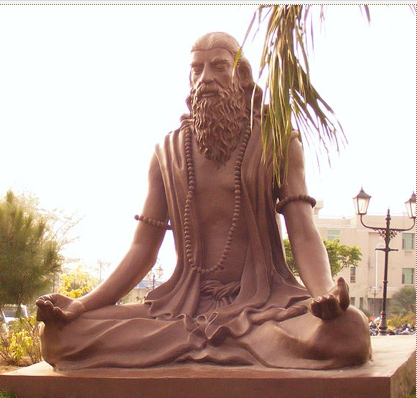
Statue of Patanjali, Haridwar, India
In the Vedanta, there are usually four classifications of consciousness: dreamless sleep, dream sleep, ordinary consciousness, and a fourth transcendental state (divided, perhaps, into varying subtle sub-states). In his yoga sutras, the ancient sage and grammarian, Patanjali, explores the three ordinary states of consciousness and how to attain, though progressively disciplining the thought waves of the mind, the fourth, transcendental state of consciousness.

In his book, "Relativity, Philosophy and Mind," the philosopher and polymath spiritual seeker, Paul Brunton, commented on these differing states of consciousness, noting:
Paul Brunton (1898-1982)
"A man never leaves Consciousness. The world comes into it as perception, that is as idea. Whether anything, object or state, comes into it or not, consciousness remains as his unchanging home. Whether asleep or awake, wrapped in himself or out in the world, his essential being remains what it is. His thoughts and sense-impressions, feelings and passions are produced by it or projected from it: they exist in dependence on it and die in it."

"(E)ven deep sleep unconsciousness is a form of this "consciousness" which transcends all the states we ordinarily know - waking, dream and deep sleep - yet includes them when they merge back into it. Such a "consciousness" is unthinkable, unimaginable, but it is the true objective awareness. It is also the I you are seeking so much. But to reach it, then you have to let go of the I which you know so well."
["The Notebooks of Paul Brunton," vol. 13, para 183-184]
In the video embedded below, Paramahansa Nithyananada comments on the classical yoga teachings of Patanjali, 2,000 year old teachings that deal extensively with the four states of consciousness in setting out the yoga techniques which are required to reach the fourth transcendental state. The problem for the vast majority of people, however, Nithyananda notes, is that even in our waking state we are prone to be absent-minded or "dreaming."

Paramahansa Nithyananda
"The whole of humanity is sleep walking, except the man who is awakened, the man who is enlightened," says Paramahansa Nethyananda in his explanation of Patanjali's yoga sutras. "Being absent-minded, not being alive in the state in which you are is what I call 'sleep.' . . . Otherwise (for) all problems you face, you have a solution."

"There is no problem which cannot be solved," he notes. "All problems can be completely solved with only one thing: You need to be available. . . . All problems are created when you are not available. When you are not available you mess up the whole thing."

"Because of absent-mindedness people miss many things," says Nithyananda, "their relationships, their life, their positions. Many things get missed. (Being) absent-mindedness during talking with others, or during your your activities, you will lose your worries. (Being) absent-mindedness during your inner planning, inner visualization, inner thinking, (we) understand is the worst one. You will miss some (important) links."

If you are "absent -mindedness in your outer world," he observes, "you lose only things of the outer world. . . . But forgetting to keep your (inner) thoughts, you lose the things that you really need in your life. You lose too many big things."


Wednesday, April 27, 2011

Emerson's Harvard Divinity School Address: Reflections on the Sublime

The dean of the American Transcendentalists, Ralph Waldo Emerson, was in many ways the forefather of the spiritual awakening that many people feel arising in our times. Heavily influenced by the first widespread introduction of Eastern wisdom teachings to the West, Emerson was a champion of the universality of religious teachings and a non-dualist, as the following excerpts from his renowned address to the Harvard Divinity School show.

The site of Ralph Waldo Emerson's
Harvard Divintiy School address.
His address, delivered in the inner sanctum of the Unitarian Church's highest seat of learning, the Harvard Divinity School address was in many ways an heroic stand that Emerson made for his then radical beliefs. Shortly thereafter, he resigned as a Unitarian minister, and although lecturing to receptive audiences worldwide, he was not invited to speak again at Harvard for another thirty years.

Some 175 years later, Emerson's observations on the nature of God and man remain as clear and relevant to our times as they were then. Indeed, they are perhaps more so today, given the current conflicts we see between and among fundamentalists of all faiths, and the spiritual awakening one nonetheless senses amongst both persons of all faiths, and of no one faith in particular. ("As we are, so we associate," Emerson observed. "The good, by affinity, seek the good; the vile, by affinity, the vile. Thus of their own volition, souls proceed into heaven, into hell.")

Ralph Waldo Emerson
(1803-1882)
In addressing his audience at the Divinity School, Emerson observed:
"The intuition of the moral sentiment is an insight of the perfection of the laws of the soul. These laws execute themselves. They are out of time, out of space, and not subject to circumstance. . . . If a man is at heart just, then in so far is he God; the safety of God, the immortality of God, the majesty of God do enter into that man with justice. If a man dissemble, deceive, he deceives himself, and goes out of acquaintance with his own being. . . . The man who renounces himself, comes to himself by so doing."

"These facts have always suggested to man the sublime creed, that the world is not the product of manifold power, but of one will, of one mind; and that one mind is everywhere, in each ray of the star, in each wavelet of the pool, active; and whatever opposes that will, is everywhere baulked and baffled, because things are made so, and not otherwise. "
In pointed and specific, yet beautiful and poetically transcendent language, Emerson observes that mankind's religious or spiritual sentiments are universal, arising in the East, yet giving truth to the 'Being' in each individual. Thus, he notes:
" . . . The perception of this law of laws always awakens in the mind a sentiment which we call the religious sentiment, and which makes our highest happiness. Wonderful is its power to charm and to command. It is a mountain air. It is the embalmer of the world. . . . It makes the sky and the hills sublime, and the silent song of the stars is it. By it, is the universe made safe and habitable, not by science or power. Thought may work cold and intransitive in things, and find no end or unity. But the dawn of the sentiment of virtue on the heart, gives and is the assurance that Law is sovereign over all natures, and the worlds, time, space, eternity, do seem to break out into joy."

" . . . This thought dwelled always deepest in the minds of men in the devout and contemplative East; not alone in Palestine, where it reached its purest expression, but in Egypt, in Persia, in India, in China. Europe has always owed to oriental genius, its divine impulses. What these holy bards said, all sane men found agreeable and true.

" . . . The divine bards are the friends of my virtue, of my intellect, of my strength. They admonish me, that the gleams which flash across my mind, are not mine, but God's; that they had the like and were not disobedient to the heavenly vision. So I love them. Noble provocations go out from them, inviting me also to emancipate myself; to resist evil to subdue the world; and to Be."


Monday, March 21, 2011

Consciouness and the Brain: Correlation or Cause?

". . . thinking without awareness
is the main dilemna of human
existence. . . ."

(Eckhart Tolle, "A New Earth," p. 32.)
What are the two greatest misunderstandings about consciousness and the psyche? I would argue, as so may others have, that the two greatest blunders - blunders which contribute to the continuing shortfall of Western science to put on an academic "full-court press" to get to the root of what 'consciousness' actually 'is' - are the blind assumptions that (a) consciousness is a 'by-product' of the brain, and (b) that when we are "conscious" (as opposed to dreaming, or hallucinating) we are actually in control of what it is we think.

As the great modern enlightenment teacher, Eckhart Tolle, has often remarked, Descartes got it absolutely wrong in making his famous declaration, "I think, therefore I am." I would, only add that he got it wrong on both counts. It seems far more likely that the thought processes and structures of the brain are the by-product of a higher order of consciousness, or at a very minimum they are shaped by consciousness. Moreover, I think that upon close observation almost everyone must concede that most of the time, when we believe we are consciously 'thinking,' we are actually being 'thunk!'

The embedded video, "Zen Biology Lesson on Enlightenment," produced by TheTruthsofLife.com, tackles both of these "false" presumptions 'head-on' (so-to-speak), while accompanied by a rather nice rendition of Vivaldi's Four Seasons.
Carl G. Jung (18 - 1961)
"The Undiscovered Self"


In his short masterpiece (see attached link), "The Undiscovered Self," the great Swiss psychologist. Carl Jung puts it this way:
"In the same way that our misconception of the solar system had to be freed from prejudice by Copernicus, the most strenuous efforts of a well-nigh revolutionary nature were needed to free psychology, first from the spell of mythological ideas, and then from the prejudice that the psyche is, on the one hand, a mere epiphenomenon of a biochemical process in the brain, or on the other hand, a wholly unapproachable and recondite matter. The connection with the brain does not in itself prove that the psyche is an epiphenomenon, a secondary function causally dependent on biochemical processes.  Nevertheless, we know only too well how much the psychic function can be disturbed by verifiable processes in the brain, and this fact is so impressive that the subsidiary nature of the psyche seems an almost unavoidable inference. . . ."

"The structure and physiology of the brain furnish no explanation of the psychic process. The psyche has a peculiar nature which cannot be reduced to anything else. Like physiology, it represents a relatively self-contained field of experience to which we must attribute a quite special importance because it holds within one of the two indispensable conditions for existence as such, namely consciousness. Without consciousness there would, practically speaking, be no world, for the world exists as such only in so far as it is consciously reflected and consciously expressed by a psyche. Consciousness is a condition of being. Thus the psyche is endowed with the dignity of a cosmic principle, which philosophically and in fact gives it a position coequal with the principle of physical being. . . ."
Western neuroscience has made great strides in mapping the neural correlates of different emotions and phenomena of consciousness, but little or no success in mapping the neural correlates of consciousness itself. There is likely no specific neural correlate and if, as Jung and others suppose, 'consciousness' is indeed aphenomenal instead of epiphenomenal in nature such a neural correlate will never be found.

Because of the strong two-way correlations between the brain and consciousness, however, mind scientists are all-too tempted to conflate correlation and causality, as Jung notes. It is high time that neuro-scientists and neuro-anatomists who expend a great deal of effort probing the brain for an objective phenomenal 'seat of consciousness' so to speak, turn with an equal effort (and open-mindedness) to the question of just what the subjective aphenomenal nature of consciousness and its many-flavoured shades are.